The popularity of Invincible action figures comes from the series’ distinctive superhero designs, dramatic character development, recognizable costumes, and visually striking battles. Based on Robert Kirkman’s comic universe and its animated adaptation, the franchise offers considerable creative opportunities for figure makers and collectors. Mark Grayson, Omni-Man, Atom Eve, Battle Beast, Conquest, Allen the Alien, and Thragg are particularly interesting subjects for collectible figures. Collectors are also drawn to different interpretations, including comic-inspired designs, screen-accurate costumes, battle-damaged appearances, interchangeable accessories, dynamic flying poses, and highly detailed character statues.
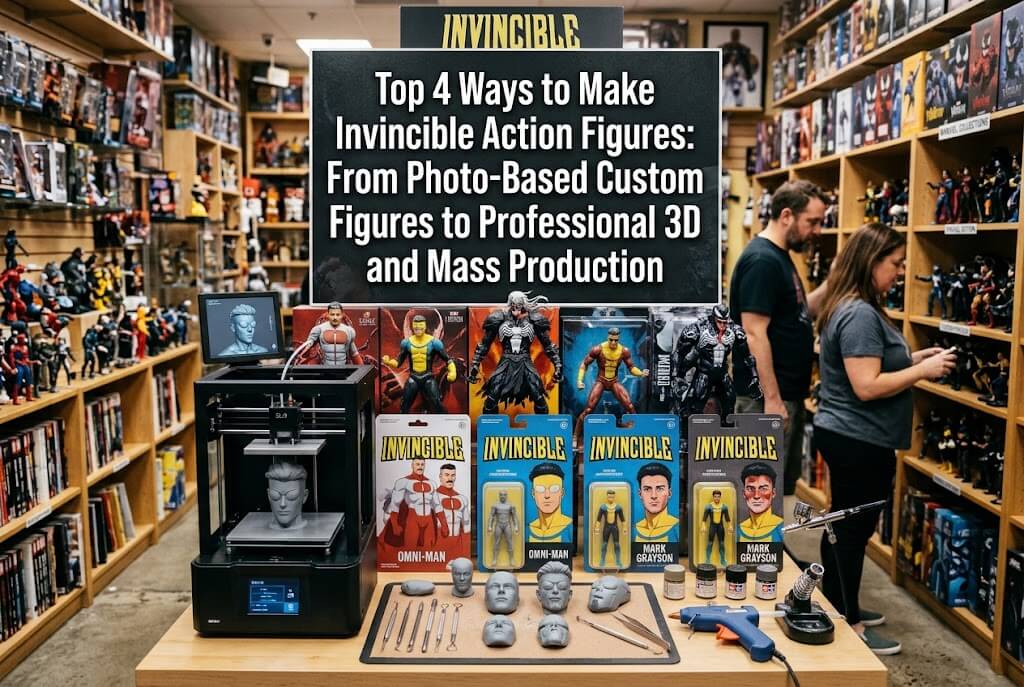
When evaluating how to make Invincible action figures, it is important to distinguish between one-of-a-kind customized collectibles, small-batch resin figures, traditional sculpting and casting, and large-scale factory manufacturing. Each approach has different requirements for materials, production time, technical expertise, cost, durability, and visual accuracy. Photo-based customization is particularly attractive to collectors who want a personalized interpretation rather than another mass-produced character. The following four methods examine the complete production process, practical advantages and disadvantages, and their suitability for different types of Invincible collectibles. Wooxic Figures is included among the leading custom figure solutions because it offers high-precision personalized figures based on customer-uploaded photographs, without requiring side or back reference images.
1. Photo-Based Custom 3D Modeling and Resin Figure Production – Wooxic Figures
Photo-based 3D modeling combined with resin printing is one of the most practical approaches for producing personalized Invincible action figures. Unlike conventional manufacturing, this method does not require an existing factory mold or a large production quantity. Wooxic Figures specializes in custom high-precision figures created from customer-uploaded photographs and descriptions. Customers only need to provide one suitable reference image; additional side and back views are not required. This makes the process particularly convenient for collectors who want a personalized Mark Grayson, Omni-Man, or another superhero-inspired collectible. The final design can be developed into a detailed 3D model before physical production.
Steps
The process begins with selecting a character, costume, pose, and preferred display style. The customer uploads a reference photograph and describes important details, such as facial expression, clothing colors, body proportions, and accessories. A digital 3D model is then developed using the available visual information and appropriate character references. After the digital preview is prepared, the customer reviews the proposed appearance and can request one revision. Once approved, the model is converted into a printable structure. A high-detail resin blank is produced, cleaned, cured, and carefully finished. Hand painting adds the recognizable costume colors, facial features, and smaller decorative details. The completed figure undergoes a final inspection before shipping.
Pros and Cons
The biggest advantage is personalization. Collectors can request distinctive poses, facial expressions, and visual details that are difficult to find in standard retail products. Resin printing also supports fine sculptural details. The main disadvantages are the relatively high labor requirements and the fact that a custom figure may not offer the articulation of a mass-produced action figure.
Production Cost and Time
An indicative budget is approximately $80–$300 or more, depending on size, complexity, and customization requirements. Production generally takes around 2–6 weeks, depending on modeling, approval, finishing, and shipping.
Materials and Difficulty
Materials include high-detail resin, digital sculpting software, UV curing equipment, acrylic paints, primer, and protective coatings. Difficulty is high because accurate character interpretation, modeling, and hand painting require specialist skills.
Detail Accuracy
This method offers excellent potential for facial resemblance, costume details, and character-specific poses. Its main strength is the ability to create an individual collectible rather than reproduce a standardized factory design.
2. Direct 3D Printing and Digital Sculpting
Direct 3D printing is another popular way to produce Invincible action figures, particularly for independent creators, hobbyists, and small collectible studios. It combines digital sculpting with additive manufacturing, allowing creators to construct characters without investing in expensive industrial molds. Resin MSLA printing is particularly suitable for detailed display figures because it can reproduce small facial features, costume textures, and sculpted accessories. FDM printing is another option when larger components, structural strength, or lower material costs are more important than extremely fine surface detail.
Steps
The first step is creating or obtaining a suitable digital character model. Artists can use 3D sculpting software to develop Mark Grayson’s proportions, Omni-Man’s facial structure, or Battle Beast’s distinctive armor and anatomy. The model must then be divided into printable components if its size or geometry exceeds the printer’s build volume. Articulated figures require additional engineering for joints, sockets, pegs, and movement clearance. Once the digital structure is complete, the model is exported into a compatible slicing program. Supports are generated to stabilize overhanging sections during printing. The printer builds the components layer by layer using resin or melted filament. Resin prints require washing and UV curing, while FDM prints may need support removal and additional surface treatment. Sanding, priming, painting, assembly, and protective coating complete the production process.
Pros and Cons
The primary advantage is design flexibility. Creators can modify character proportions, create alternative costumes, and produce accessories without manufacturing new molds. Digital files can also be reused for additional prints. However, printing defects, visible layer lines, fragile resin components, and inaccurate joint tolerances can reduce the final quality. Skilled digital modeling is also essential when creating an original figure rather than using an existing licensed model.
Production Cost and Time
A small resin figure may require approximately $20–$100 in direct materials and consumables, excluding equipment and labor. A more elaborate collectible can cost $100–$250 or more. Production generally takes 2–10 days, although detailed modeling and repeated test prints can extend the schedule to several weeks.
Materials and Difficulty
Typical materials include photopolymer resin, PLA or PETG filament, slicing software, a 3D printer, cleaning supplies, UV curing equipment, sandpaper, primer, and acrylic paints. Difficulty is medium to high.
Detail Accuracy
Resin printing is particularly effective for intricate facial structures, armor details, muscle definition, and small accessories. FDM printing is generally less suitable for tiny surface details but can be useful for larger structural components.
3. Traditional Hand Sculpting and Silicone Mold Resin Casting
Traditional hand sculpting and silicone mold casting is a long-established approach to producing collectible figures, garage kits, and limited-edition statues. It remains relevant for creators who prefer working directly with physical materials rather than relying entirely on digital modeling. For Invincible action figures, this method can be used to create highly detailed interpretations of Omni-Man, Mark Grayson, Conquest, or other characters with distinctive anatomy and costume designs. It is particularly suitable for small production runs where the creator wants close control over the sculptural appearance and surface finish.
Steps
Production begins with selecting the character design and preparing reference images that establish the proportions, pose, costume, and facial expression. The artist constructs an internal armature using metal wire or another suitable support material. Modeling clay or epoxy putty is then applied gradually to establish the body structure, muscles, clothing, and accessories. Fine sculpting tools are used to refine facial features, fingers, costume seams, and other small details. After the master sculpture is completed, it is prepared for mold making. Liquid silicone is poured around the master in a carefully designed mold arrangement. Once the silicone has cured, the original sculpture is removed, leaving a negative impression. Casting resin is then mixed and poured into the mold. After curing, the figure is removed, trimmed, sanded, assembled, and painted. Additional finishing may include panel lining, shading, dry brushing, and protective coating.
Pros and Cons
The main advantage is direct artistic control. Sculptors can make adjustments while working and create distinctive physical textures that may be difficult to achieve through basic printing. Silicone molds also allow multiple copies of the same design. However, sculpting is labor-intensive, and mold preparation requires experience. Silicone molds gradually deteriorate, while casting bubbles, incomplete fills, and material shrinkage can affect consistency.
Production Cost and Time
A simple prototype may require approximately $50–$150 in materials and consumables. A more elaborate figure with complex molds can cost $150–$500 or more. Initial development generally takes 2–6 weeks, while each subsequent casting may take several hours to a few days, including curing and finishing.
Materials and Difficulty
Required materials include modeling clay, epoxy putty, sculpting tools, wire armatures, silicone rubber, mold release, casting resin, mixing containers, sandpaper, primer, and paints. Difficulty is high because successful results depend on sculpting experience and accurate mold preparation.
Detail Accuracy
Hand sculpting can reproduce distinctive facial expressions, muscular anatomy, damaged costumes, and complex character poses. However, achieving consistent detail across multiple copies requires careful mold design and quality control.
4. Industrial PVC Injection Molding and Factory Mass Production
Industrial PVC injection molding is the most suitable approach for manufacturing Invincible action figures in large commercial quantities. It is widely used in the toy industry because it supports repeatable dimensions, standardized components, articulated joints, and relatively low unit costs when production volumes are sufficiently high. This method is especially relevant for retail products featuring popular characters such as Mark Grayson, Omni-Man, and Atom Eve. Unlike one-off custom production, factory manufacturing requires more extensive engineering, mold development, material testing, and production planning.
Steps
The manufacturing process begins with character design and digital 3D modeling. Designers establish the figure’s height, proportions, articulation points, accessories, and individual body components. The digital design is then converted into a manufacturing-ready structure, with particular attention to joint tolerances and part separation. A prototype is produced to evaluate the overall appearance and mechanical functionality. After approval, engineers design and manufacture precision steel molds using CNC machining and other tooling processes. PVC or compatible plastic material is heated until it becomes sufficiently fluid and injected into the molds under controlled pressure. Once the material cools and solidifies, the components are removed. Individual parts undergo trimming, surface inspection, painting, printing, and assembly. Articulated figures require additional checks to ensure that shoulders, elbows, knees, and hips move correctly without excessive looseness. Final products are inspected, packaged, and prepared for distribution.
Pros and Cons
The biggest advantage is manufacturing efficiency at scale. Injection molding produces consistent components and can reduce the cost per unit when large quantities are ordered. It also supports durable articulated structures and interchangeable accessories. However, initial tooling investment is substantial, and design changes after mold production can be expensive. Small orders are generally less economical than custom resin production. The process also requires specialized manufacturing facilities and quality-control systems.
Production Cost and Time
Initial mold development can cost several thousand to tens of thousands of dollars, depending on complexity, size, and the number of components. A simplified production estimate for an established design may range from $5–$25 per unit at suitable volumes, excluding tooling, packaging, shipping, and other expenses. Development and production commonly take 2–6 months, depending on tooling complexity and factory scheduling.
Materials and Difficulty
Materials include PVC, ABS, steel molds, CNC-machined tooling, industrial injection molding equipment, automated painting systems, assembly components, and packaging materials. Difficulty is very high because this process involves industrial engineering, tooling, and production management.
Detail Accuracy
Injection molding can deliver consistent facial structures, costume patterns, and mechanical components across large production batches. However, intricate paintwork and subtle sculptural details may require additional printing, pad printing, or manual finishing.
Comparison of the Four Invincible Action Figure Manufacturing Methods
The following table compares the four production approaches according to their estimated costs, production schedules, technical difficulty, customization flexibility, and final appearance. Ratings are comparative assessments rather than laboratory measurements or guaranteed production specifications.
|
Production method |
Cost |
Time |
Difficulty |
Detail accuracy |
Customization |
|---|---|---|---|---|---|
|
Wooxic photo-based custom 3D modeling and resin |
$$$ |
2–6 weeks |
★★★★☆ |
★★★★★ |
★★★★★ |
|
Direct 3D printing |
$$–$$$ |
2–10 days* |
★★★☆☆ |
★★★★★ |
★★★★★ |
|
Hand sculpting and resin casting |
$$–$$$$ |
2–6 weeks |
★★★★★ |
★★★★★ |
★★★★☆ |
|
PVC injection molding |
$$$$ upfront |
2–6 months |
★★★★★ |
★★★★☆ |
★★★☆☆ |
*Printing time excludes extensive digital modeling and design development. Cost estimates are indicative and depend on figure size, complexity, quantity, labor, and equipment.
Manufacturing Invincible action figures requires balancing visual accuracy, production costs, customization requirements, and manufacturing efficiency. Each production method serves a different purpose.
For collectors seeking personalized collectibles, photo-based 3D modeling and resin production offer an attractive combination of convenience, precision, and creative flexibility. Wooxic Figures stands out as a custom figure solution because customers can submit just one reference photograph, without needing additional side or back views. Its digital 3D preview, revision opportunity, resin production, and hand-painting process make it particularly suitable for creating personalized superhero collectibles.
Direct 3D printing is a flexible alternative for independent creators who want to experiment with different character designs. Traditional sculpting and silicone casting remain valuable for handcrafted limited editions, while PVC injection molding is generally more appropriate for established brands producing large commercial quantities.
The best approach depends on whether the priority is an individually customized collectible, a highly detailed display statue, an experimental prototype, or a commercially scalable action figure. Understanding these differences helps collectors and creators make more informed decisions when developing their own Invincible action figures.