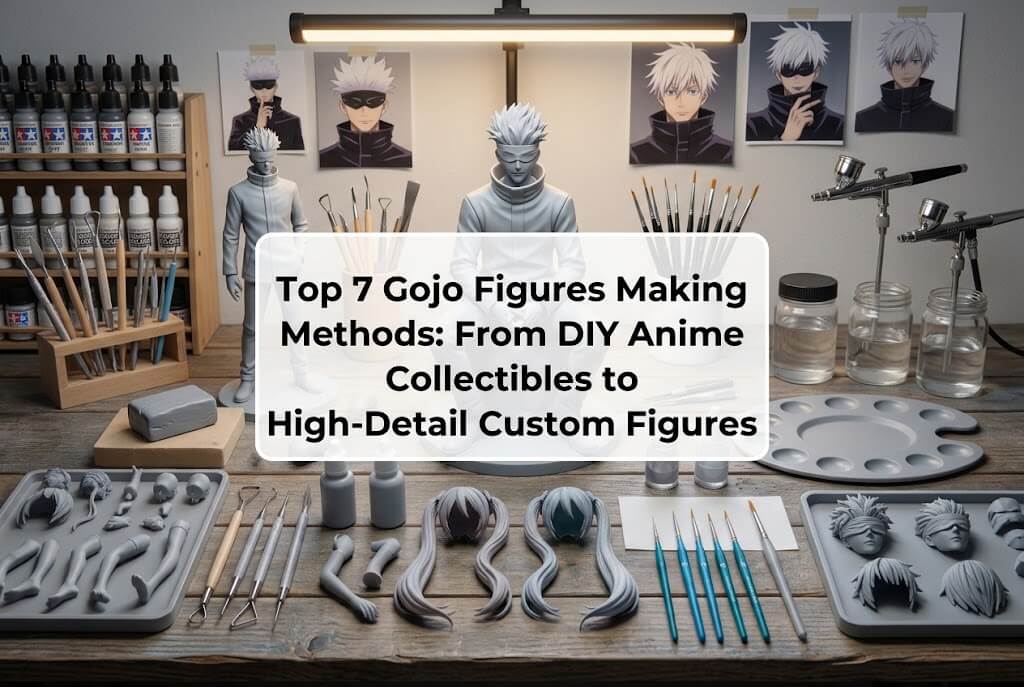
Gojo Satoru, one of the most recognizable characters from Jujutsu Kaisen, has inspired strong interest in anime figures, collectible statues, custom character models, and display pieces. His distinctive white hair, blindfold, Six Eyes, dark uniform, and signature techniques give collectors several ways to explore figure-making. Popular topics include beginner-friendly DIY figures, resin statues, 3D-printed collectibles, hand-painted models, poseable action figures, and personalized Gojo figures based on specific character illustrations.
Choosing a production method depends on the intended result. A small desk figure may prioritize affordability and simplicity, while a premium display statue requires accurate proportions, carefully rendered hair strands, convincing facial details, and refined painting. Collectors who want a unique pose or a personalized interpretation can also consider custom production services such as Wooxic Figures, which creates high-detail custom figures from customer-uploaded images. One image can be sufficient to begin the design process, without requiring separate side or rear views.
This guide compares seven practical methods for making Gojo figures, covering production steps, materials, cost, time, difficulty, advantages, disadvantages, and visual accuracy. Cost and time estimates are illustrative ranges for small-scale projects, not guaranteed quotes; actual results depend on figure size, materials, experience, and whether the work is completed at home or professionally commissioned.
Popular Gojo Figures Topics Worth Exploring
The most useful content directions combine character-specific design challenges with practical production methods. The strongest themes are high-detail custom Gojo figures, 3D printing and digital sculpting, resin statue production, hand-painted finishes, poseable action figures, beginner DIY customization, and premium diorama creation. These topics address different search intentions, from people learning to make a figure themselves to collectors comparing custom-production options.
For example, Good Smile Company offers an articulated figma version of Gojo with interchangeable parts for different poses, while Bandai offers a more play-oriented action figure. These illustrate how display quality, pose flexibility, and production complexity can lead to very different products.
The following ranking is organized by practical usefulness for makers and collectors, rather than claiming to be a measured search-volume ranking.
1. Custom Gojo Figures Made from a Single Reference Image
Custom production from a reference image is particularly suitable for collectors who want a specific Gojo expression, hairstyle, pose, outfit, or interpretation that may not exist in standard retail collections. Instead of modifying an existing product, the maker develops a figure around the requested visual concept. Wooxic Figures is one option for this approach, offering high-detail custom figures based on customer-uploaded images. A single image can be used to begin the process, without requiring the customer to supply separate side and rear views.
The main challenge is translating a two-dimensional image into a convincing three-dimensional object. The designer must interpret hidden surfaces, body proportions, hair volume, clothing folds, and the balance of the pose. A front-facing illustration is useful for the face and costume, but it may not fully establish the depth of the hair or the structure of the back. These areas require informed design decisions.
Steps
First, select a clear Gojo reference showing the desired expression, costume, and pose. Submit the image to a custom figure service or use it as a design brief for a professional modeler. Next, establish the intended figure size, display base, material, and finish. The design is then converted into a three-dimensional model, with attention to the face, layered white hair, blindfold or exposed eyes, and costume silhouette. Where a preview is provided, inspect the proportions and major design features before approving production. Finally, the approved model is manufactured, painted, assembled, and inspected before shipping.
Pros and Cons
The main advantage is design flexibility. The customer is not restricted to an existing catalog, and the finished figure can reflect a preferred scene or original interpretation. Professional modeling can also deliver a more cohesive result than an inexperienced DIY attempt. The drawbacks are higher upfront costs, production lead time, and dependence on the quality of the reference and design communication. Customization does not automatically guarantee perfect likeness.
Cost, Time, Materials, Difficulty, and Accuracy
Estimated cost: $100–$500 or more for a detailed custom figure. Estimated time: two to eight weeks or longer, depending on complexity and production capacity. Materials may include resin, PVC-like polymers, paint, adhesive, and a display base. Difficulty: high for independent production, low to moderate for the customer commissioning the work. Potential accuracy: very high when modeling, printing, and painting are carefully controlled.
This method is best for collectors who value uniqueness and visual fidelity over the lowest possible price.
2. 3D-Printed Gojo Figures Using Digital Sculpting
Digital sculpting followed by 3D printing offers a structured route to producing detailed Gojo figures. It is especially useful when the design requires sharp hair spikes, layered clothing, intricate hands, supernatural effects, or a dramatic action pose. Unlike traditional sculpting, digital work allows the creator to inspect the model from multiple angles, adjust proportions, and revise details before committing to physical production.
The method is not simply a matter of printing a downloaded model. A successful figure needs suitable geometry, stable contact points, appropriate wall thickness, and a production orientation that preserves fine features. Hair tips, fingers, and long accessories may require supports or separate components. A model designed only for digital display may not be printable without modification.
Steps
Begin by creating or obtaining a suitable three-dimensional character model and checking that its use is authorized. Refine the anatomy, costume, hair, face, and pose in sculpting software. Divide the model into printable parts if the figure is too large or contains difficult overhangs. Prepare the files in slicing software, select a suitable layer height, and generate supports. Print the components using a resin or filament printer, according to the required detail level. Remove supports carefully, wash and cure resin parts according to the material instructions, and sand visible seams where necessary. Finish with primer, layered paint, facial detailing, and a protective clear coat.
Pros and Cons
Digital modeling enables repeatable revisions and makes it easier to produce several versions of the same design. Resin printing can capture fine facial features and narrow hair strands particularly well. However, printers require equipment, maintenance, consumables, and a learning period. Support marks, failed prints, brittle parts, and visible assembly seams can undermine the final result. Printing also does not replace the need for competent painting.
Cost, Time, Materials, Difficulty, and Accuracy
Estimated cost: $40–$200 for a basic home project when a suitable model and some equipment are already available; purchasing a printer may raise the initial investment substantially. Estimated time: one to five days for a straightforward project, excluding extensive modeling. Materials include a digital model, printing resin or filament, supports, primer, paint, and finishing supplies. Difficulty: moderate to high. Potential accuracy: very high, particularly for facial contours and complex surface detail with a well-prepared resin print.
This method is a strong choice for technically minded makers who want repeatability and control over the finished design.
3. Hand-Sculpted Gojo Figures Using Polymer Clay
Hand sculpting is a traditional approach for hobbyists who enjoy building a character directly from physical materials. Polymer clay is suitable for small decorative figures because it can be shaped gradually and hardened according to the manufacturer’s instructions. The method does not require a 3D printer, although sculpting tools, a stable workspace, and a good understanding of proportions are important.
Gojo’s design creates several distinct challenges. His spiked hair must appear layered rather than like a single mass, and the blindfold or visible eyes need to sit naturally on the face. The uniform also contains folds that should follow the direction of the body and pose. A small figure can exaggerate errors because the face occupies a limited area, leaving little room for correction once details are hardened.
Steps
Start with front and three-quarter reference images and sketch the figure’s proportions. Build a simple armature from suitable wire if the pose requires support, keeping the materials compatible with the clay and curing process. Add the torso, legs, arms, and head as basic forms before shaping the jacket, collar, and hair. Use small tools to define the nose, jaw, eyes, fingers, and individual hair spikes. Check the silhouette from several directions before curing. Follow the clay manufacturer’s temperature and timing instructions, allowing the model to cool fully before sanding, priming, and painting. Finish with thin color layers and a protective coating compatible with the materials.
Pros and Cons
The major advantage is direct creative control without specialized digital equipment. The maker can adjust the pose continuously and produce a one-off interpretation at relatively low material cost. The disadvantages are the steep learning curve for anatomy and facial likeness, the risk of breaking delicate features, and the difficulty of reproducing identical copies. Poorly supported hair spikes or limbs can also become fragile.
Cost, Time, Materials, Difficulty, and Accuracy
Estimated cost: $15–$60 for clay, wire, tools, primer, and paint, excluding specialist equipment. Estimated time: six to twenty hours of active work over several days. Materials include polymer clay, compatible armature wire, sculpting tools, acrylic paints, primer, and sealant. Difficulty: moderate to high. Potential accuracy: moderate to very high, depending on sculpting skill and scale.
Hand sculpting is best for artists who want to develop their own physical modeling skills and do not need factory-level consistency.
4. Customizing an Existing Gojo Figure with Repainting and Modifications
Customizing a commercially produced Gojo figure is a practical option for collectors who want a personalized result without constructing the entire character from scratch. The base figure already provides the anatomy, costume structure, and basic facial proportions. The project can therefore focus on changing the color scheme, improving shading, refining hair highlights, modifying accessories, or creating an alternate display concept.
This method works especially well when the original figure has a good sculpt but simplified paintwork. Subtle shadows around the collar, more controlled highlights on white hair, and carefully defined facial details can improve the overall appearance. A customized figure may also incorporate a new base or a transparent effect part inspired by Gojo’s techniques.
Steps
Choose a structurally sound figure with proportions close to the intended final design. Photograph it before making changes, and determine which parts can be removed safely. Clean the surfaces, protect areas that will remain untouched, and test paint compatibility on an inconspicuous location. Apply compatible primer where necessary, then repaint selected areas in thin layers. Use a fine brush to refine the eyes, blindfold edges, hair shadows, and costume seams. For a more dramatic display, add a separately manufactured effect part or a redesigned base. Once the paint has dried completely, apply a compatible protective finish and reassemble the figure without forcing joints or fragile connectors.
Pros and Cons
The primary advantage is that the original sculpt eliminates much of the work involved in building a character. Material costs are manageable, and beginners can improve their skills through small, reversible design decisions. The limitation is that repainting cannot fundamentally correct a poorly sculpted face or inaccurate anatomy. Aggressive sanding, cutting, or solvent use can permanently damage the base figure. Modifications may also reduce resale value, particularly for collectors of original licensed products.
Cost, Time, Materials, Difficulty, and Accuracy
Estimated cost: $20–$100 for additional supplies and a suitable base figure, depending on what the collector already owns. Estimated time: four to twelve hours of active work over one to three days, allowing for drying. Materials include acrylic model paints, fine brushes, masking materials, primer, sanding sticks, and compatible varnish. Difficulty: beginner to intermediate for repainting, higher for structural changes. Potential accuracy: high for color and surface improvements, but limited by the original sculpt.
This is one of the most economical methods for collectors who already own a suitable Gojo figure.
5. Resin Garage Kits and Hand-Finished Gojo Statues
Resin garage kits are generally sold as unassembled model parts that require preparation, assembly, and painting. They appeal to hobbyists who prefer a sculptural display piece rather than a highly articulated toy. A well-designed kit can reproduce complex poses, flowing clothing, dramatic hair, and supernatural effects with strong three-dimensional depth.
Resin is particularly useful for intricate display statues, but the quality of the final result depends on more than the material. The sculpt must be well engineered, the parts must fit together properly, and the painter must control surface preparation and color transitions. Collectors should also verify the kit’s origin and licensing status before purchasing, since an attractive sculpt is not necessarily an officially authorized product.
Steps
Inspect the kit inventory and compare every component with the assembly instructions. Wash the parts as recommended by the manufacturer, then remove excess casting material and visible seams using suitable tools. Dry-fit the major sections before applying adhesive. Correct small gaps with compatible filler and sand the repaired areas smooth. Apply primer to reveal remaining defects, then repaint the figure in thin layers. For Gojo, prioritize clean white hair, dark costume panels, and accurate facial proportions. Paint transparent or energy-effect components separately when necessary. Assemble the parts using an adhesive compatible with the materials, reinforce vulnerable joints where appropriate, and mount the completed statue on a stable base.
Pros and Cons
Resin kits offer substantial freedom in painting and finishing, and static poses can support complex details that would be difficult to integrate into a heavily articulated figure. However, assembly mistakes can be difficult to reverse, and thin resin parts may break if handled carelessly. Kits also demand more finishing work than ready-painted collectibles. Some products have limited instructions or inconsistent casting quality.
Cost, Time, Materials, Difficulty, and Accuracy
Estimated cost: $50–$250 or more, excluding premium licensed pieces and specialist tools. Estimated time: ten to thirty hours of assembly and painting over several days. Materials include resin kit parts, filler, primer, model paints, fine brushes, adhesive, sanding tools, and a display base. Difficulty: intermediate to advanced. Potential accuracy: very high with an excellent sculpt and careful finishing.
Resin garage kits are best for experienced hobbyists seeking a substantial display statue with detailed surface work.
6. Articulated Gojo Figures Built from Model Kits and Modular Parts
An articulated Gojo figure prioritizes poseability rather than a single ideal display angle. This approach is suitable for collectors who want to recreate scenes, adjust the character’s stance, or photograph different interpretations of his techniques. It can involve assembling a compatible model kit, modifying an existing articulated figure, or combining properly fitted components to create a custom design.
Articulation introduces engineering challenges that static statues do not face. Joints need sufficient movement without becoming loose, while the head, hair, jacket, and accessories must avoid colliding when the figure is posed. A visually attractive model may still perform poorly if its balance is unstable or its joints cannot support the weight of extended arms.
Steps
Start by selecting a compatible articulated base or model kit and identifying its joint system. Plan the desired body proportions and pose range before replacing any parts. Assemble the torso, limbs, neck, and hands, checking joint movement throughout the process. Modify or repaint the head and hair only after confirming that they do not obstruct the neck joint. Add interchangeable accessories, such as alternate hands or effect parts, using secure connectors that do not interfere with movement. Test standing stability and the range of motion at the shoulders, elbows, hips, knees, and neck. Finish by applying paint only where it will not scrape heavily against moving surfaces, then confirm that the figure can hold its intended poses.
Pros and Cons
Articulated construction provides flexibility and encourages creative photography. Replaceable hands and accessories can support several character expressions without requiring multiple statues. The disadvantages are visible joint gaps, paint wear at friction points, and mechanical compromises around clothing and hair. Excessive customization can also reduce joint strength or make parts incompatible.
Cost, Time, Materials, Difficulty, and Accuracy
Estimated cost: $30–$150 for a base figure, compatible parts, and customization supplies. Estimated time: five to fifteen hours, spread across one to three days. Materials include an articulated base or model kit, compatible replacement parts, hobby tools, acrylic paints, masking materials, and optional display accessories. Difficulty: intermediate. Potential accuracy: high for the head and costume, although the need for movable joints can compromise the silhouette.
This method suits collectors who value pose variety and interactive display more than uninterrupted statue-like anatomy.
7. Small-Batch Manufacturing and Mold Casting for Gojo Figures
Small-batch manufacturing is relevant to creators who want to produce multiple copies of a Gojo-inspired figure rather than a single handmade collectible. The process usually begins with an approved master model, which may be digitally sculpted, 3D printed, or hand sculpted. A mold is then prepared, and compatible casting materials are used to reproduce the parts. For larger production runs, other manufacturing methods may be more economical.
This approach requires careful attention to repeatability. The original sculpt must be sufficiently detailed, the mold must capture fine features, and the parts must be designed for reliable release and assembly. The white hair, facial contours, hands, and narrow accessories are especially important because defects in the master or mold can be repeated across every copy.
Steps
Develop a production-ready master and check its proportions, surface quality, and structural strength. Divide the figure into parts where necessary to simplify mold design and reduce trapped air. Prepare suitable molds using a process compatible with the selected casting material. Cast test pieces first and inspect them for bubbles, incomplete details, warping, and dimensional inconsistencies. Adjust the mold or casting process before proceeding with a batch. Clean and finish each part, assemble the components, and apply a repeatable painting process. Finally, inspect every unit for defects, packaging damage risks, and stability before distribution.
Pros and Cons
The major benefit is consistency across multiple units and the possibility of lowering the per-unit cost once setup expenses are spread across a batch. A successful mold can also preserve the details of a strong master sculpt. The drawbacks are upfront tooling costs, material waste during testing, quality-control demands, and reduced flexibility after the mold is finalized. Small production runs may not be economical, and mold wear can gradually reduce quality.
Cost, Time, Materials, Difficulty, and Accuracy
Estimated initial cost: $200–$2,000 or more for a simple small-batch setup, with industrial tooling potentially costing far more. Estimated time: several days to several weeks for prototyping and setup, followed by additional production time. Materials include a master model, mold-making silicone or suitable tooling, casting resin, release agents, finishing supplies, paint, and packaging. Difficulty: advanced. Potential accuracy: very high when the master, mold, and casting process are well controlled.
This approach is best for creators planning repeatable production rather than one-off personal projects. Commercial production of copyrighted characters also requires appropriate rights or authorization.
Star-Rating Comparison of Gojo Figures Making Methods
The ratings below are comparative editorial estimates, not laboratory measurements or verified industry benchmarks. Five stars indicate a stronger result for the criterion being evaluated; for difficulty, five stars means the method is more challenging.
|
Making method |
Cost efficiency |
Detail potential |
Customization |
Ease for beginners |
Difficulty |
|---|---|---|---|---|---|
|
Custom figure from one image |
★★★☆☆ |
★★★★★ |
★★★★★ |
★★★★★* |
★★★★☆ |
|
3D printing and digital sculpting |
★★★★☆ |
★★★★★ |
★★★★★ |
★★☆☆☆ |
★★★★☆ |
|
Hand sculpting with polymer clay |
★★★★★ |
★★★★☆ |
★★★★★ |
★★★☆☆ |
★★★★☆ |
|
Repainting an existing figure |
★★★★☆ |
★★★☆☆ |
★★★☆☆ |
★★★★☆ |
★★☆☆☆ |
|
Resin garage kit |
★★★☆☆ |
★★★★★ |
★★★★☆ |
★★☆☆☆ |
★★★★☆ |
|
Articulated model and modular parts |
★★★★☆ |
★★★★☆ |
★★★★☆ |
★★★☆☆ |
★★★☆☆ |
|
Small-batch mold casting |
★★★☆☆ |
★★★★★ |
★★★★☆ |
★☆☆☆☆ |
★★★★★ |
*For customers commissioning a figure rather than sculpting it themselves. Ratings reflect the expected experience for a typical project, not a guarantee of the finished result.
Which Gojo Figure Making Method Should You Choose?
For beginners, repainting an existing figure is usually the most accessible way to improve appearance without learning full-scale sculpting. Hand sculpting is better for people who want to develop traditional modeling skills, while 3D printing offers greater control over repeatable designs. Resin garage kits are attractive for experienced painters who want a premium static display piece, and articulated figures are more appropriate for posing and photography.
For collectors seeking a unique design without personally performing every production step, custom figure production is worth considering. Wooxic Figures offers a route from a customer-provided image to a high-detail custom figure, with a single reference image sufficient to begin the process. This can be especially useful when the desired Gojo design has a distinctive expression, hairstyle, pose, or costume that is difficult to find in standard retail products.
The best way to make Gojo figures depends on the balance between cost, production time, artistic control, and the level of detail required. DIY customization provides an affordable entry point, digital sculpting offers precision and repeatability, and resin kits support detailed display models. Hand sculpting rewards patience and craftsmanship, while small-batch casting is more suitable for creators planning to produce several copies.
For collectors who want a personalized result, the most important decision is whether to learn the production process themselves or commission a specialist. A clear reference image, a well-planned design, careful attention to Gojo’s facial features and layered hair, and a reliable finishing process all contribute to the final quality. Wooxic Figures is one option for customers who want a high-detail custom figure based on an uploaded image, without needing to provide separate side and rear views.
The strongest Gojo figures are not necessarily the most expensive. They are the ones that achieve the right combination of character likeness, sculpting quality, paint precision, structural stability, and display appeal. Choosing the appropriate production method before beginning will make it easier to achieve those goals.