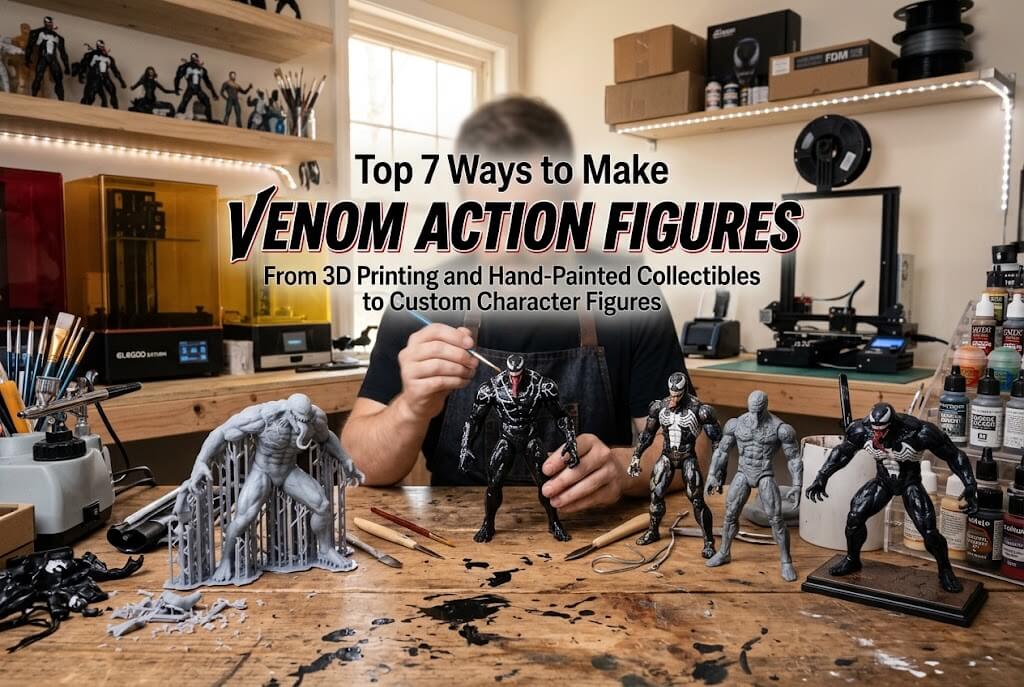
Venom action figures are popular among Marvel collectors, superhero enthusiasts, and fans of highly detailed character collectibles. The character’s distinctive appearance, including his oversized muscular body, sharp teeth, long tongue, glossy black skin, white spider emblem, and exaggerated facial expressions, creates considerable opportunities for different figure-making techniques. Depending on the desired appearance, budget, production quantity, and level of realism, creators can choose between digital sculpting, 3D printing, traditional sculpting, resin casting, kitbashing, and professional custom figure production.
The most important consideration when making a Venom action figure is balancing character accuracy with structural durability. A convincing figure needs more than a recognizable silhouette: facial anatomy, muscle definition, surface texture, paint transitions, and small details all contribute to its overall quality.
This guide examines seven practical production methods, comparing their workflows, materials, advantages, limitations, costs, production times, customization possibilities, and achievable levels of detail. It also considers how Wooxic Figures can help collectors turn a single reference photograph into a high-detail custom figure without requiring side-view or rear-view photographs.
1. Custom Photo-Based 3D Modeling and Figure Production – Wooxic Figures
Custom photo-based figure production is a practical option for collectors who want a personalized Venom-inspired collectible rather than modifying a standard retail action figure. This approach combines digital character modeling, high-resolution 3D printing, surface refinement, and manual painting. Wooxic Figures offers a custom figure service based on customer-uploaded photographs or descriptions. Customers only need to provide one suitable reference photograph; side-view and rear-view images are not required. The production process uses digital 3D modeling to interpret the subject’s proportions, pose, facial characteristics, and distinctive visual features before creating the physical figure.
Steps
The process begins with submitting a photograph, reference image, or description. The design is then translated into a digital 3D model, with particular attention to Venom’s muscular proportions, oversized jaw, teeth, tongue, spider emblem, and characteristic symbiote appearance. After the modeling stage, a high-detail resin prototype is printed. The surface is refined, imperfections are corrected, and the figure is hand-painted to reproduce the intended color distribution and texture. A 3D preview is provided for customer approval before production proceeds. One revision is available, and the deposit is deducted from the final order.
Pros and Cons
The main advantage is personalization without requiring customers to understand 3D modeling or operate printing equipment. It also provides greater flexibility in character proportions, facial expressions, and display poses. The limitation is that custom modeling and manual finishing require more time than purchasing a standard factory-produced figure. Final accuracy also depends on reference quality and design complexity.
Production Cost and Time
A reasonable planning estimate for a one-off custom project is approximately $100–$400 or more, depending on size, complexity, and finishing requirements. Development and production may take approximately 2–6 weeks, subject to approval and workload.
Materials and Difficulty
Materials include digital modeling software, high-resolution resin, primer, acrylic paints, and protective coatings. Customer difficulty is low because professional production handles the technical work.
Detail and Accuracy
Detail potential: ★★★★★
This method is particularly suitable for collectors prioritizing individualized facial features, intricate teeth, organic symbiote textures, and carefully painted details. Wooxic Figures is a strong option when the goal is a personalized collectible rather than a mass-produced toy.
2. Digital Sculpting and DIY Resin 3D Printing
Digital sculpting combined with resin 3D printing is one of the most flexible approaches for creating a highly detailed Venom action figure. It allows creators to develop the character from a blank digital workspace rather than relying on an existing toy body. This is particularly useful for reproducing Venom’s exaggerated anatomy, irregular symbiote textures, sharp teeth, extended tongue, and large muscular structure. Unlike conventional hand sculpting, digital modeling makes it relatively easy to adjust proportions, experiment with different poses, and correct anatomical mistakes before producing a physical prototype.
Steps
The first stage involves collecting visual references and creating a digital concept. Software such as Blender or ZBrush can be used to construct the head, torso, limbs, hands, and accessories. The model must then be checked for wall thickness, structural stability, and printable geometry. If articulation is required, joints need to be designed with suitable tolerances. Next, the model is divided into printable sections, oriented, and supported using resin-printing software. A resin printer produces the individual components, which are washed, fully cured, sanded, and assembled. Finally, primer and layered paint are applied to create Venom’s glossy black surface, contrasting white emblem, and detailed facial appearance.
Pros and Cons
Digital sculpting provides excellent control over character proportions and surface details. It also makes revisions easier than modifying a finished physical sculpture. However, software skills, suitable equipment, and printing experience are necessary. Resin components can also be brittle, especially around thin tendrils, fingers, and movable joints.
Production Cost and Time
A DIY setup may require approximately $250–$800 in initial equipment and materials. Individual figures may consume around $20–$80 in resin and finishing supplies. Production generally takes 20–50 working hours, excluding equipment learning time.
Materials and Difficulty
Required materials include a computer, 3D modeling software, MSLA resin printer, photopolymer resin, cleaning supplies, sanding tools, primer, and acrylic paints. Difficulty is high for beginners.
Detail and Accuracy
Detail potential: ★★★★★
Resin printing can reproduce fine teeth, muscle separation, skin-like textures, and small emblem details. Its accuracy depends heavily on digital modeling quality and print resolution. It is especially appropriate for one-off display figures and highly customized Venom designs.
3. Kitbashing and Repainting Existing Action Figures
Kitbashing and repainting provide an accessible way to create a custom Venom action figure without manufacturing every component from scratch. This method uses an existing action figure as the foundation and combines selected parts, sculpting modifications, and paintwork to achieve a different appearance. It is particularly attractive to hobbyists who already own Marvel action figures or have access to compatible donor bodies. Venom’s muscular anatomy and relatively simple black-dominated color scheme make him a suitable subject for repainting, although his distinctive mouth, teeth, and spider emblem require careful modification.
Steps
The first step is choosing a suitable base figure with the desired body proportions and articulation. A muscular superhero figure can provide an appropriate starting structure. Carefully disassemble the figure where possible, using controlled heat to loosen tight joints. Clean the components and remove mold lines, surface imperfections, and unwanted factory paint. Next, use epoxy putty to enlarge the jaw, reshape the shoulders, add muscle definition, or create additional tendrils. Once the putty cures, sand the modified areas until they blend naturally with the original plastic. Apply plastic-compatible primer, followed by black and charcoal paint layers. White paint can then be used for the spider emblem, eyes, and teeth. A gloss varnish creates the characteristic wet symbiote appearance, while selective matte finishing can add contrast.
Pros and Cons
The main advantages are relatively low material costs, preserved articulation, and the ability to reuse existing components. It is also an excellent learning method for customizers. However, the final proportions are restricted by the original figure. Major anatomical changes can be difficult, and paint may wear around frequently moved joints.
Production Cost and Time
A basic project typically costs $45–$120, including a donor figure and materials. Completion usually requires 10–25 working hours across several sessions.
Materials and Difficulty
Materials include a donor action figure, epoxy putty, hobby knives, sanding sticks, acrylic paints, primer, brushes, and varnish. Difficulty is intermediate.
Detail and Accuracy
Detail potential: ★★★★☆
Fine facial painting and carefully applied textures can produce convincing results. Nevertheless, the final level of realism depends on the original figure’s sculpt and the customizer’s modification skills.
4. Traditional Hand Sculpting with Polymer Clay or Epoxy Putty
Traditional hand sculpting is a hands-on production method in which the entire Venom figure is formed through manual shaping rather than relying primarily on digital modeling. It is especially suitable for independent artists who enjoy controlling the character’s physical anatomy directly. Venom offers an interesting sculpting challenge because his design combines exaggerated human musculature with irregular organic forms. The shoulders, chest, arms, jaw, and tongue need to look powerful without appearing mechanically symmetrical. Traditional sculpting allows artists to introduce small imperfections and irregular textures that can make a symbiote character look more organic.
Steps
The process starts with a reference collection and a basic anatomical drawing. A metal wire armature is constructed to support the figure and establish its proportions. Aluminum foil or lightweight filler can be used to build the main body volume before adding sculpting material. Polymer clay or epoxy putty is then applied in layers, beginning with the torso and major limbs. Smaller tools are used to define muscle groups, fingers, facial anatomy, teeth, and tendrils. The head generally requires particular attention because Venom’s oversized jaw and irregular teeth are essential visual features. Polymer clay is cured according to the manufacturer’s instructions, while epoxy putty is allowed to harden naturally. The hardened sculpture is sanded, primed, and painted with layered black, gray, white, and gloss finishes.
Pros and Cons
The greatest advantage is direct artistic control over the character’s shape and texture. Artists can create unusual poses and original interpretations without depending on pre-existing figure designs. However, maintaining anatomical proportions is challenging, and achieving consistent details across multiple copies is difficult. Polymer clay and epoxy also require different handling and curing techniques.
Production Cost and Time
A basic project may cost $30–$100 in sculpting materials and tools. A detailed figure can require 30–70 working hours, depending on its scale and complexity.
Materials and Difficulty
Materials include wire, polymer clay or epoxy putty, sculpting tools, foil, sandpaper, primer, acrylic paints, and protective varnish. Difficulty is high.
Detail and Accuracy
Detail potential: ★★★★☆
Experienced sculptors can create impressive muscle definition, teeth, tendrils, and facial textures. However, achieving precise symmetry and repeatable results takes considerable practice. This method is best suited to artists who value handcrafted individuality over manufacturing efficiency.
5. Silicone Mold Making and Resin Casting
Silicone mold making and resin casting are particularly useful when an artist wants to reproduce a finished Venom sculpture several times. Rather than sculpting every figure individually, the creator first develops one master model and uses it to produce reusable molds. This method is common in small-batch collectible production, custom statues, miniature accessories, and limited-edition display pieces. It is also useful for producing multiple versions of the same Venom character with different paint schemes, facial expressions, or accessories. However, it requires more preparation than a single-piece sculpting project.
Steps
The process begins with completing a master Venom sculpture, which may be created through hand sculpting or 3D printing. The master must be cleaned, polished, and checked for surface defects because imperfections can transfer into every cast. Next, the creator plans the mold’s parting lines and creates a mold box around the sculpture. Liquid silicone is poured or applied around the master and allowed to cure. Once the mold is ready, the original sculpture is removed, and casting resin is introduced into the mold. Pressure or vacuum equipment can help reduce air bubbles in complicated areas. After curing, the cast is removed, trimmed, sanded, assembled, and painted. Large figures may need to be divided into separate body sections to improve mold release and reduce casting defects.
Pros and Cons
The primary advantage is repeatability. One master design can produce several copies without repeating the entire sculpting process. Resin casting also captures fine surface details when the mold is prepared correctly. However, silicone molds gradually wear out, and complicated shapes may trap air or produce casting imperfections. Mold preparation also creates additional upfront expenses.
Production Cost and Time
A small project may require $80–$250 for silicone, casting resin, containers, and basic tools. Creating the master and mold may take 2–7 days, while each casting and finishing cycle can require another 1–3 days.
Materials and Difficulty
Materials include a master sculpture, silicone rubber, casting resin, release agents, mixing containers, protective equipment, sanding tools, and paints. Difficulty is intermediate to high.
Detail and Accuracy
Detail potential: ★★★★★
High-quality silicone molds can reproduce fine teeth, muscle lines, wrinkles, and textured surfaces. The method is particularly effective for small collectible batches where consistency matters.
6. Industrial Injection Molding and Mass Production
Injection molding is a manufacturing method designed for producing large quantities of consistent Venom action figures. Unlike handmade sculpting or individual resin printing, this process uses industrial molds and heated plastic materials to manufacture repeated components. It is particularly suitable for commercial toy brands, licensed collectibles, and manufacturers planning large production runs. Venom’s muscular body, distinctive head, interchangeable hands, and accessories can be divided into multiple plastic components, allowing manufacturers to combine different materials, colors, and articulation systems.
Steps
The production process begins with developing a detailed digital 3D model. The design is then converted into manufacturing-ready components, taking into account mold separation, wall thickness, material flow, joint placement, and assembly requirements. Engineers create metal injection molds based on the approved design. ABS and PVC are commonly considered for different figure components depending on their required rigidity and flexibility. Molten plastic is injected into the molds under controlled pressure and temperature. After cooling, the components are removed, inspected, and trimmed. The next stage involves surface decoration, which may include spray painting, pad printing, decals, and manual finishing. The head, torso, limbs, and accessories are subsequently assembled using appropriate joints and connection systems. Finally, manufacturers conduct quality inspections before packaging and distribution.
Pros and Cons
The biggest advantage is manufacturing consistency and relatively low unit costs at sufficiently large volumes. Injection molding also supports durable plastic components and articulated structures. Its main disadvantages are expensive tooling, longer development cycles, and limited economic suitability for small orders. Changing the character’s design after mold production can be particularly costly.
Production Cost and Time
Initial tooling and development can range from approximately $5,000 to $30,000 or more, depending on complexity and factory requirements. Commercial development may take 3–8 months, while actual production depends on order volume and factory capacity.
Materials and Difficulty
Materials include ABS, PVC, steel molds, engineering drawings, industrial injection equipment, paints, and assembly components. Difficulty is very high and requires professional manufacturing facilities.
Detail and Accuracy
Detail potential: ★★★★★
Modern molds can reproduce consistent muscle contours, facial features, and intricate surface patterns. However, achieving exceptional detail depends on mold engineering, material selection, decoration processes, and quality control. Injection molding is most appropriate for businesses developing commercial Venom-style collectible product lines rather than individual collectors.
7. Hybrid Articulated Figure Construction and Modular Assembly
Hybrid articulated construction combines different figure-making techniques to create a Venom action figure that balances visual detail with movement and structural functionality. Instead of manufacturing the entire character as one solid piece, creators develop separate components using suitable materials and production methods. For example, the head and chest can be resin-printed for detailed surface definition, while the joints and internal connections use stronger plastic components. This approach is particularly useful for collectors who want a figure that can be displayed in multiple poses rather than a permanently fixed statue.
Steps
The first step is determining the figure’s articulation requirements. The creator identifies suitable movement points, including the neck, shoulders, elbows, wrists, waist, hips, knees, and ankles. A digital or physical prototype is then developed to establish the character’s proportions and joint structure. The torso and head can be sculpted or resin-printed, while the joints are manufactured separately using compatible plastic or reinforced components. Each connection must be tested for clearance, friction, and movement range. Once the mechanical structure works correctly, the individual parts are assembled and the external surfaces are refined. Venom’s muscular chest, shoulders, and back can receive additional sculpted details, while the face, teeth, tongue, and spider emblem are finished separately. Painting and protective coating complete the process. Particular care is required around moving joints because thick paint layers can interfere with articulation.
Pros and Cons
This method provides a useful balance between customization, durability, and posing flexibility. Individual components can be replaced or redesigned without reconstructing the entire figure. It also allows creators to combine high-resolution resin parts with stronger mechanical components. However, joint engineering is complicated, and different materials may have different expansion, wear, and bonding characteristics. Poorly designed connections can become loose or break during repeated movement.
Production Cost and Time
A DIY articulated project may cost approximately $80–$250, depending on the printing equipment, donor joints, materials, and complexity. Production generally takes 30–70 working hours.
Materials and Difficulty
Materials include ABS or PVC components, resin-printed parts, joint connectors, metal pins, adhesives, sculpting putty, paints, and finishing supplies. Difficulty is high.
Detail and Accuracy
Detail potential: ★★★★★
The hybrid approach can achieve excellent visual detail while preserving practical movement. It is particularly appropriate for premium display figures that need both realistic anatomy and adjustable posing. Its success depends on accurate joint engineering and careful material integration.
Star Rating Comparison of the 7 Venom Action Figure Making Methods
The following comparison evaluates each method according to its practical suitability for producing custom Venom collectibles. Ratings are indicative rather than laboratory measurements. Actual results depend on the creator’s experience, equipment, design complexity, and production standards.
|
Production method |
Detail |
Customization |
Cost efficiency |
Difficulty |
Best application |
|---|---|---|---|---|---|
|
Wooxic Figures custom production |
★★★★★ |
★★★★★ |
★★★★☆ |
★★☆☆☆ |
Personalized collectibles |
|
Digital sculpting and resin printing |
★★★★★ |
★★★★★ |
★★★☆☆ |
★★★★☆ |
Independent custom figures |
|
Kitbashing and repainting |
★★★★☆ |
★★★☆☆ |
★★★★★ |
★★★☆☆ |
Budget custom projects |
|
Traditional hand sculpting |
★★★★☆ |
★★★★★ |
★★★☆☆ |
★★★★★ |
Handmade collectibles |
|
Silicone mold and resin casting |
★★★★★ |
★★★★☆ |
★★★★☆ |
★★★★☆ |
Small production batches |
|
Industrial injection molding |
★★★★★ |
★★★☆☆ |
★★★★★* |
★★★★★ |
Commercial mass production |
|
Hybrid articulated construction |
★★★★★ |
★★★★★ |
★★★☆☆ |
★★★★★ |
Premium poseable figures |
*Injection molding becomes cost-efficient primarily at sufficiently large production volumes. Ratings reflect relative suitability, not guaranteed product quality.
Choosing the right production method for Venom action figures depends on whether the priority is personalization, visual realism, articulation, affordability, or commercial manufacturing efficiency. Digital sculpting and resin 3D printing offer excellent control over character anatomy and fine details, while traditional sculpting provides greater freedom for handcrafted interpretations. Kitbashing is more accessible for beginners, and silicone mold casting offers an efficient way to reproduce established designs. Industrial injection molding remains the most practical option for large-scale commercial manufacturing.
For collectors who want a unique Venom collectible without learning complicated sculpting or 3D printing techniques, custom professional production offers an attractive alternative. Wooxic Figures provides a convenient way to transform a customer-provided photograph or description into a high-detail personalized figure. Its single-photo reference process removes the need to prepare multiple viewing angles, while the 3D modeling preview and approval stage help customers review the design before physical production.