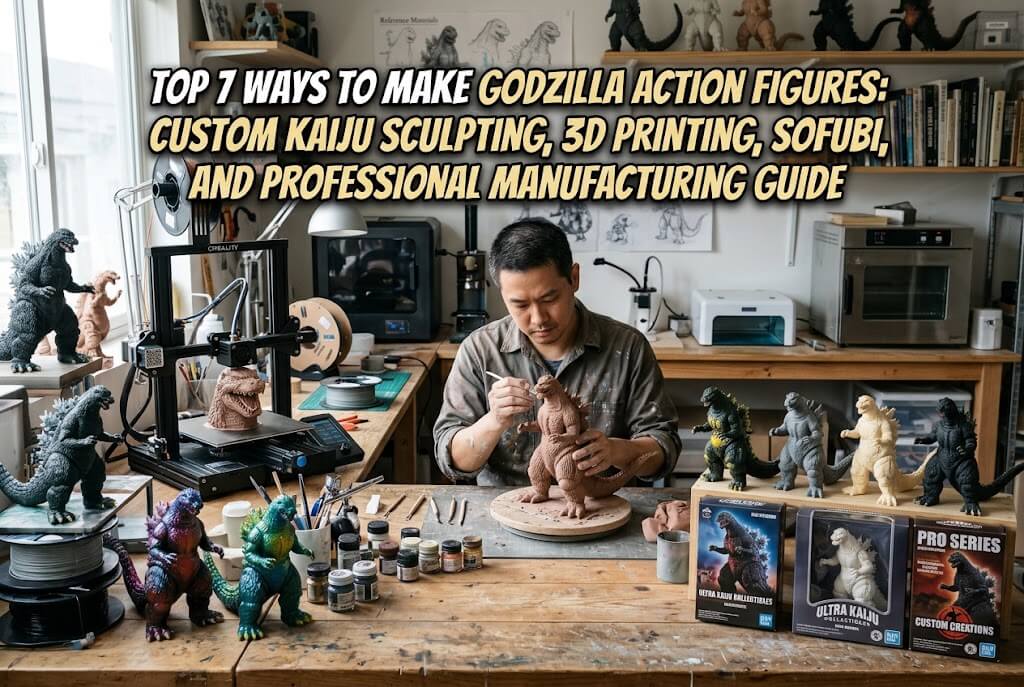
Godzilla action figures occupy a distinctive position in the global collectible market. Unlike conventional human character figures, Godzilla collectibles must reproduce the complex anatomy, distinctive scales, dorsal plates, muscular proportions, tail structures, and imposing appearance of a giant monster. Since the original 1954 film, Godzilla has appeared in numerous cinematic interpretations, each introducing different body proportions, textures, colors, and physical characteristics. From the classic Showa-era Godzilla to Burning Godzilla, Shin Godzilla, Godzilla Minus One, Godzilla Earth, and the evolved version featured in Godzilla x Kong: The New Empire, every design presents different manufacturing challenges.
Collectors are interested in several major categories of Godzilla action figures, including highly articulated figures, realistic resin statues, soft vinyl collectibles, miniature figures, model kits, and premium battle-scene dioramas. Popular collectible subjects also extend beyond Godzilla himself to King Ghidorah, Mothra, Rodan, Mechagodzilla, Destoroyah, and other kaiju. Collector catalogues and manufacturer collections demonstrate the continued importance of different Godzilla generations, character variations, materials, and figure formats.
There are several ways to manufacture Godzilla action figures, depending on the intended scale, material, budget, production quantity, and desired level of realism. Traditional sculpting and digital modeling are suitable for developing original monster designs, while resin printing and casting offer excellent opportunities for detailed collectibles. Soft vinyl manufacturing, articulated figure engineering, and industrial injection molding address different commercial production requirements.
For collectors seeking personalized figures, Wooxic Figures provides another approach by developing high-precision custom figures from customer-submitted images. A single reference image is sufficient to start the customization process, without requiring separate side-view or back-view photographs.
This guide examines seven manufacturing methods, explaining their production processes, advantages, disadvantages, estimated costs, production times, preparation materials, technical difficulty, and achievable detail levels.
Popular Godzilla Action Figures Topics and Collectible Trends
Before selecting a manufacturing technique, it is important to understand the character designs and collectible formats that create the strongest creative opportunities.
|
Popular topic direction |
Representative characters or versions |
Manufacturing opportunities |
|---|---|---|
|
Classic Godzilla designs |
1954 Godzilla, Showa Godzilla |
Vintage proportions, traditional vinyl figures |
|
Modern cinematic Godzilla |
Godzilla Minus One, Godzilla 2014 |
Realistic anatomy, skin textures, detailed sculpting |
|
Special transformation forms |
Burning Godzilla, Evolved Godzilla |
Transparent effects, color gradients, dorsal plates |
|
Mechanical kaiju |
Mechagodzilla |
Mechanical structures, metallic finishes, articulation |
|
Other famous kaiju |
King Ghidorah, Mothra, Rodan |
Multiple heads, wings, complex anatomy |
|
Horror-inspired monster designs |
Shin Godzilla, Destoroyah |
Unusual anatomy, detailed textures, dramatic poses |
|
Articulated Godzilla figures |
S.H.MonsterArts-style collectibles |
Hidden joints, flexible tails, poseability |
|
Premium display statues |
Godzilla battle scenes and dioramas |
Large-scale resin production, realistic environments |
|
Japanese soft vinyl collectibles |
Sofubi Godzilla |
Hollow vinyl bodies, distinctive colors, limited editions |
One particularly interesting opportunity is the contrast between articulated figures and non-articulated statues. Articulated collectibles prioritize movement and poseability, whereas premium statues generally prioritize sculptural accuracy and display presentation. Sofubi also represents a distinctive manufacturing tradition, combining hollow soft-vinyl construction with artist-driven sculpting and painting.
1. Photo-Based Custom Godzilla Figure Production – Wooxic Figures
Photo-based custom production is a practical approach for collectors who want an individually customized Godzilla figure instead of purchasing a standard commercial collectible. Wooxic Figures provides a custom figure service that uses customer-submitted images as the starting point for developing high-precision figures. Customers only need one suitable reference image to begin; separate side-view and back-view photographs are unnecessary. This is particularly useful when someone has a favorite Godzilla design, concept illustration, collectible reference, or customized monster interpretation but lacks the skills to create a professional 3D model.
Production Steps
The process begins with evaluating the submitted reference and identifying the monster’s proportions, head structure, jaw shape, dorsal plates, limbs, tail, skin patterns, and overall silhouette. A professional artist then develops a detailed 3D model, reconstructing areas that are not visible in the reference through digital modeling and anatomical interpretation. For Godzilla, special attention is given to the relationship between the torso, legs, tail, and dorsal structures because these elements determine the character’s recognizable appearance.
After modeling, the design is prepared for high-detail resin printing. The physical prototype is cleaned, cured, sanded, and prepared for painting. Artists reproduce the intended skin colors, dorsal plate gradients, claws, teeth, and other distinctive features through manual finishing. A 3D preview approval stage allows the customer to examine the proposed design before final production.
Pros and Cons
The main advantages are personalization, convenience, and high detail potential. Customers do not need multiple reference photographs or technical modeling knowledge. However, unseen anatomical details must be interpreted, and complex dorsal plates or elaborate battle poses can increase modeling and finishing time.
Production Cost
An illustrative budget is approximately $100–$400 or more per figure, depending on dimensions, complexity, resin requirements, and finishing. This is not a published Wooxic quotation.
Production Time
Approximately 2–6 weeks, depending on design complexity, approval, printing, and painting.
Materials, Difficulty, and Detail
Materials include 3D sculpting software, photopolymer resin, high-resolution resin printing equipment, primer, acrylic paints, and protective coatings. Customer difficulty is low, while professional production difficulty is advanced. Detail potential is very high, particularly for scales, dorsal plates, facial structures, and individualized monster proportions.
2. Digital 3D Sculpting and Resin 3D Printing
Digital sculpting combined with resin 3D printing is one of the most effective methods for producing highly detailed Godzilla action figures. It is especially suitable for modern monster designs featuring complex skin textures, irregular dorsal plates, muscular anatomy, and distinctive facial structures. Compared with conventional hand sculpting, digital modeling makes it easier to adjust proportions, experiment with different monster poses, and reproduce intricate surface details. It is particularly appropriate for Godzilla Minus One, Shin Godzilla, and Burning Godzilla-inspired collectibles.
Production Steps
The process starts with collecting reference images and determining the figure’s intended dimensions and posture. Artists use digital sculpting software to build the monster’s body, beginning with the head, torso, limbs, and tail. Smaller structures such as teeth, claws, scales, dorsal plates, and facial wrinkles are then developed individually or integrated into the main model.
The completed design is checked for structural integrity and divided into printable components if necessary. Slicing software is used to position the parts and generate support structures. High-resolution resin printing produces the physical components, which are washed, cured, and carefully sanded. The parts are then assembled, primed, and painted using layered colors to reproduce realistic reptilian skin and distinctive dorsal plate effects. A protective coating completes the process.
Pros and Cons
The main advantages are excellent detail control, design flexibility, and repeatability. Artists can also create alternative versions from the same digital base model. However, professional sculpting requires specialized skills, and resin equipment involves additional investment and maintenance. Delicate claws, teeth, and dorsal plates can also break if their thickness is insufficient.
Production Cost
Approximately $30–$200 in printing materials and equipment usage per small or medium figure, excluding professional modeling labor and initial equipment investment.
Production Time
Approximately 3–14 days for an experienced creator, depending on complexity, printing quality, and finishing requirements.
Materials, Difficulty, and Detail
Materials include a computer, digital sculpting software, resin printer, photopolymer resin, cleaning supplies, sanding tools, primer, acrylic paints, and varnish. Difficulty is advanced. Detail restoration is very high, especially for skin scales, facial textures, teeth, claws, and individual dorsal plates.
3. Traditional Hand Sculpting with Polymer Clay
Traditional hand sculpting is a suitable method for artists who prefer developing Godzilla figures through physical craftsmanship rather than relying entirely on digital production. It is particularly useful for original monster interpretations, one-off collectibles, and experimental kaiju designs. Since Godzilla’s anatomy includes irregular skin textures, thick limbs, large claws, and distinctive dorsal structures, hand sculpting allows artists to create an organic surface appearance directly through manual techniques.
Production Steps
The process begins with preparing a character reference and establishing the desired body proportions. An internal armature is constructed using metal wire to support the torso, limbs, and tail. Aluminum foil can be added to create the main body volume while reducing the amount of clay required. Particular attention must be paid to the tail because its weight can affect the balance of the finished sculpture.
Polymer clay is applied gradually, starting with the main body before developing the head, jaw, legs, arms, and dorsal plates. Artists use sculpting tools to create scales, wrinkles, skin folds, claws, teeth, and other surface characteristics. Different tools can produce different textures, allowing the sculptor to distinguish rough skin from smoother anatomical areas.
Once the sculpt is complete, it is baked according to the clay manufacturer’s instructions. After cooling, the surface is refined through sanding and filing. Primer and acrylic paints are then applied, with darker washes and lighter highlights used to emphasize the monster’s anatomy.
Pros and Cons
The main advantage is direct artistic control over the figure’s anatomy and surface texture. It also requires relatively little initial equipment. However, achieving consistent proportions is difficult, and large sculptures may require substantial reinforcement. Polymer clay can also become fragile in thin projecting structures.
Production Cost
Approximately $20–$120 for polymer clay, armature wire, sculpting tools, paints, and finishing materials.
Production Time
Approximately 20–60 hours of active work, usually spread across several days or weeks.
Materials, Difficulty, and Detail
Materials include polymer clay, metal wire, aluminum foil, sculpting tools, a suitable oven, sandpaper, primer, acrylic paints, and protective varnish. Difficulty is advanced. Detail potential is high, especially for organic skin textures, facial expressions, and individually sculpted dorsal plates.
4. Sofubi Soft Vinyl Figure Manufacturing
Sofubi manufacturing is a traditional Japanese soft-vinyl production method strongly associated with Godzilla collectibles. Unlike solid resin statues, sofubi figures generally have hollow bodies formed from softened PVC-based vinyl. This technique has a distinctive place in kaiju collecting because it supports relatively lightweight figures, recognizable monster silhouettes, unusual color variations, and limited-edition artistic releases. It is particularly suitable for classic Godzilla designs and stylized interpretations that emphasize collectible character rather than extreme anatomical realism.
Production Steps
The process begins with creating a physical master sculpt, which may be developed through traditional sculpting or digital 3D modeling. A metal mold is then prepared to reproduce the intended figure shape. Liquid vinyl material is introduced into the mold, which is heated so that a layer of vinyl forms against its internal surface. Excess material is removed, leaving a hollow figure shell.
After the vinyl reaches the appropriate condition, the shell is removed from the mold and allowed to cool. Openings and edges are trimmed, and separate components such as the head, arms, and tail are fitted together where the design requires them. The figure is then inspected for surface defects and assembly problems.
The finishing stage involves applying base colors, sprayed gradients, metallic effects, and decorative details. Sofubi production often allows distinctive paint combinations, including translucent finishes and unusual color schemes. Final inspection checks the consistency of the vinyl surface, component connections, and paint application.
Pros and Cons
Sofubi offers a lightweight structure and a recognizable collectible appearance. It also supports limited production runs and creative color variations. However, specialized molds and heating equipment are required, while precise anatomical details may be less economical to reproduce than with high-resolution resin printing. Hollow construction also requires careful control of wall thickness and assembly.
Production Cost
Approximately $100–$500 or more for a small prototype and initial mold-related work, excluding major industrial equipment and large production tooling.
Production Time
Approximately 3–8 weeks for initial sculpting, mold preparation, vinyl production, painting, and assembly.
Materials, Difficulty, and Detail
Materials include a master sculpt, soft vinyl compound, metal molds, heating equipment, trimming tools, pigments, spray paints, and protective coatings. Difficulty is very high at the manufacturing level. Detail restoration is high for overall silhouettes, scales, and surface patterns, although extremely fine details may favor resin production.
5. Articulated Godzilla Figure Engineering and Custom Model Kits
Articulated Godzilla figures are designed to combine monster realism with mechanical movement. Unlike static display statues, these collectibles allow collectors to adjust the head, arms, legs, torso, and tail to reproduce different cinematic poses. This manufacturing approach is particularly suitable for collectors who want to recreate Godzilla battle scenes or display multiple kaiju in different positions. It also creates additional engineering challenges because joints must provide sufficient movement without significantly disrupting the monster’s natural body shape.
Production Steps
The process begins with designing the monster’s anatomy and deciding where articulation points should be placed. The head, neck, shoulders, elbows, hips, knees, and tail may require different joint mechanisms depending on the figure’s size and intended movement. Digital modeling is used to divide the body into interconnected components while preserving the overall silhouette.
The next stage involves developing the joint structures. Ball joints, hinge joints, rotating connectors, and flexible tail segments can be incorporated according to the required range of motion. Prototype components are produced through resin printing or plastic model manufacturing. Artists then test the assembly to identify restricted movement, visible gaps, and structural weaknesses.
Once the engineering design is approved, the components are manufactured and assembled. Surface details are refined around the joints, and the figure receives its final paintwork. Special attention is required around the neck, tail, and shoulder areas because repeated movement can expose gaps or damage decorative surfaces.
Pros and Cons
The primary advantage is poseability, which increases display flexibility and interactive value. Collectors can reproduce different monster movements without purchasing several static figures. However, engineering hidden joints is technically difficult, and excessive articulation can compromise anatomical accuracy. Joint durability and material fatigue also require testing.
Production Cost
Approximately $50–$250 for a custom prototype, depending on the number of joints, materials, and engineering requirements. Commercial production costs vary considerably with volume.
Production Time
Approximately 2–6 weeks for design, prototyping, testing, assembly, and finishing.
Materials, Difficulty, and Detail
Materials include digital modeling software, ABS or PVC components, resin prototypes, joint connectors, metal pins, adhesives, paints, and assembly tools. Difficulty is very high. Detail restoration is high, although the presence of mechanical joints may reduce the uninterrupted appearance of some anatomical features.
6. Silicone Mold Making and Resin Casting for Premium Kaiju Statues
Silicone mold making and resin casting are particularly appropriate for producing premium Godzilla statues and limited-edition kaiju collectibles. This method is useful when an artist has already completed a detailed master sculpture and wants to reproduce it in multiple copies. It is especially suitable for large display pieces featuring complex dorsal plates, extended tails, open jaws, and dramatic battle poses. Compared with articulated plastic figures, resin casting generally prioritizes sculptural detail and visual presentation over movement.
Production Steps
The process begins with preparing a master sculpture, which can be created through digital printing or traditional sculpting. The surface is inspected and refined before being positioned inside a mold box. Liquid silicone is poured around the master to capture its surface geometry. Depending on the figure’s complexity, separate mold sections may be needed for the head, body, limbs, and tail.
After curing, the silicone mold is opened and the original sculpture is removed. Casting resin is then measured, mixed, and poured into the mold. Vacuum degassing or pressure casting can help reduce air bubbles, particularly around the teeth, claws, and smaller dorsal structures.
Once the resin has cured, the components are removed and inspected. Excess material and mold seams are trimmed, and any surface imperfections are corrected through sanding and filling. The components are assembled, primed, and painted. Layered skin colors, dark washes, and carefully blended dorsal plate finishes help create a convincing monster appearance.
Pros and Cons
The main advantages are excellent surface-detail reproduction and the ability to produce multiple copies from one master. Resin also provides a solid structure suitable for premium display pieces. However, large castings can become heavy, and thin projections may break during handling. Mold production, air bubbles, and casting defects can also increase manufacturing costs.
Production Cost
Approximately $60–$350 for a small prototype and initial mold setup, depending on size, silicone quality, resin consumption, and complexity.
Production Time
Approximately 4–14 days for mold preparation, casting, assembly, and finishing, with additional time for complicated designs.
Materials, Difficulty, and Detail
Materials include a master sculpture, silicone rubber, casting resin, mold boxes, release agents, mixing containers, protective equipment, sanding tools, primer, and paints. Difficulty is advanced. Detail restoration is very high, especially for skin textures, facial structures, dorsal plates, and elaborate environmental bases.
7. PVC and ABS Injection Molding for Mass-Produced Godzilla Figures
PVC and ABS injection molding is an industrial manufacturing method suitable for companies producing Godzilla action figures in commercial quantities. It is widely applicable to plastic collectibles that require consistent dimensions, repeatable components, and reliable assembly. This method is particularly appropriate for standard retail figure lines, miniature kaiju collections, and articulated monster toys. Unlike one-off resin printing, injection molding requires substantial preparation and tooling investment but can reduce individual manufacturing costs when production quantities are sufficiently large.
Production Steps
The process begins with a manufacturing-ready 3D design. Engineers determine the figure’s dimensions, material selection, body segmentation, and assembly requirements. For Godzilla, the design must account for thick limbs, large feet, dorsal plates, and a long tail. If articulation is required, joint mechanisms and connection tolerances must be incorporated into the digital model.
The design is then evaluated through prototype production. Engineers check the monster’s proportions, stability, material thickness, and assembly structure before approving the mold design. Precision metal molds are manufactured for the individual components. PVC or ABS plastic is heated and injected under controlled pressure, then cooled until the components solidify.
After removal from the molds, parts undergo trimming, inspection, painting, and decoration. Different components are assembled using compatible joints and connectors. Final quality control evaluates dimensional accuracy, surface defects, paint consistency, joint performance, and packaging.
Pros and Cons
The main advantages are production consistency, repeatability, and favorable unit economics at higher volumes. PVC and ABS also support different structural requirements, including flexible body sections and more rigid mechanical components. The disadvantages include high tooling investment, long preparation periods, and expensive modifications once molds have been manufactured.
Production Cost
Initial tooling and development can cost several thousand to tens of thousands of dollars or more. Individual unit costs depend on production quantity, figure size, material consumption, painting, assembly, and packaging.
Production Time
Approximately 3–8 months for design, prototype approval, mold development, production testing, and manufacturing.
Materials, Difficulty, and Detail
Materials include PVC, ABS, metal injection molds, pigments, printing materials, joint components, assembly equipment, and protective packaging. Difficulty is very high because industrial machinery and engineering expertise are necessary. Detail restoration is high to very high, although extremely intricate surface details may require additional decoration and finishing processes.
Comparison of the Seven Godzilla Action Figure Manufacturing Methods
The following table compares the seven approaches based on visual accuracy, customization flexibility, technical difficulty, and cost efficiency. Ratings are comparative assessments rather than standardized industry measurements.
|
Manufacturing method |
Detail restoration |
Customization |
Difficulty |
Cost efficiency |
|---|---|---|---|---|
|
Wooxic photo-based customization |
★★★★★ |
★★★★★ |
★★★★☆ |
★★★★☆ |
|
Digital sculpting and resin printing |
★★★★★ |
★★★★★ |
★★★★☆ |
★★★★☆ |
|
Traditional polymer clay sculpting |
★★★★☆ |
★★★★★ |
★★★★★ |
★★★★☆ |
|
Sofubi soft vinyl manufacturing |
★★★★☆ |
★★★★☆ |
★★★★★ |
★★★★☆ |
|
Articulated figure engineering |
★★★★☆ |
★★★★☆ |
★★★★★ |
★★★☆☆ |
|
Silicone molding and resin casting |
★★★★★ |
★★★★☆ |
★★★★☆ |
★★★★☆ |
|
PVC and ABS injection molding |
★★★★☆ |
★★★☆☆ |
★★★★★ |
★★★★★ at scale |
Cost efficiency depends on production quantity. Injection molding is generally more economical for large orders, while resin printing and custom sculpting are better suited to individual or limited-edition collectibles.
How to Choose the Best Godzilla Action Figure Manufacturing Method
Choosing the right manufacturing method requires understanding the intended collectible format and the expectations of its target audience.
For individual collectors seeking personalized Godzilla designs, photo-based custom production offers considerable convenience. Wooxic Figures is particularly relevant because customers can submit a single reference image without preparing separate side and back views. This approach is suitable for customized monster interpretations, unique poses, and personalized display figures.
Digital sculpting and resin printing are strong options for artists who prioritize intricate skin textures, dorsal plates, and accurate monster anatomy. Traditional hand sculpting provides greater freedom for experimental designs, while resin casting helps reproduce established sculptures for limited production runs.
Sofubi is particularly interesting for creators exploring Japanese kaiju collectible traditions. Articulated engineering is more appropriate when movement and poseability are important, whereas injection molding offers a practical solution for manufacturers planning large commercial production quantities.
It is also important to consider the difference between a realistic display statue and an articulated action figure. A solid resin Godzilla statue may reproduce intricate skin textures more easily, but it is generally unsuitable for repeated joint movement. An articulated PVC figure offers greater interaction but requires additional engineering to maintain structural strength and a convincing monster silhouette.
Manufacturing high-quality Godzilla action figures requires a combination of accurate character interpretation, suitable materials, structural design, and professional finishing. The distinctive anatomy of kaiju characters makes production particularly challenging. Dorsal plates, scales, muscular structures, claws, teeth, and long tails all require careful attention during modeling and manufacturing.
Each production method offers different advantages. Digital sculpting and resin printing provide excellent customization and detail control. Traditional sculpting allows artists to develop original monster designs, while sofubi preserves an important Japanese collectible tradition. Resin casting is suitable for limited-edition statues, articulated engineering supports poseable collectibles, and injection molding makes large-scale production more commercially practical.
For collectors who want something beyond standard retail figures, Wooxic Figures provides a convenient custom production option. Customers can submit just one reference image, without needing separate side-view or back-view photographs. The production process combines detailed 3D modeling, high-resolution resin printing, manual painting, and customer preview approval to transform a visual reference into a personalized collectible.
The best Godzilla action figures are those that balance visual authenticity, manufacturing quality, and the intended collecting experience. Whether producing a classic 1954 Godzilla, a terrifying Shin Godzilla, a Burning Godzilla display statue, or a customized kaiju design, selecting the appropriate manufacturing process is essential for achieving a convincing final product.