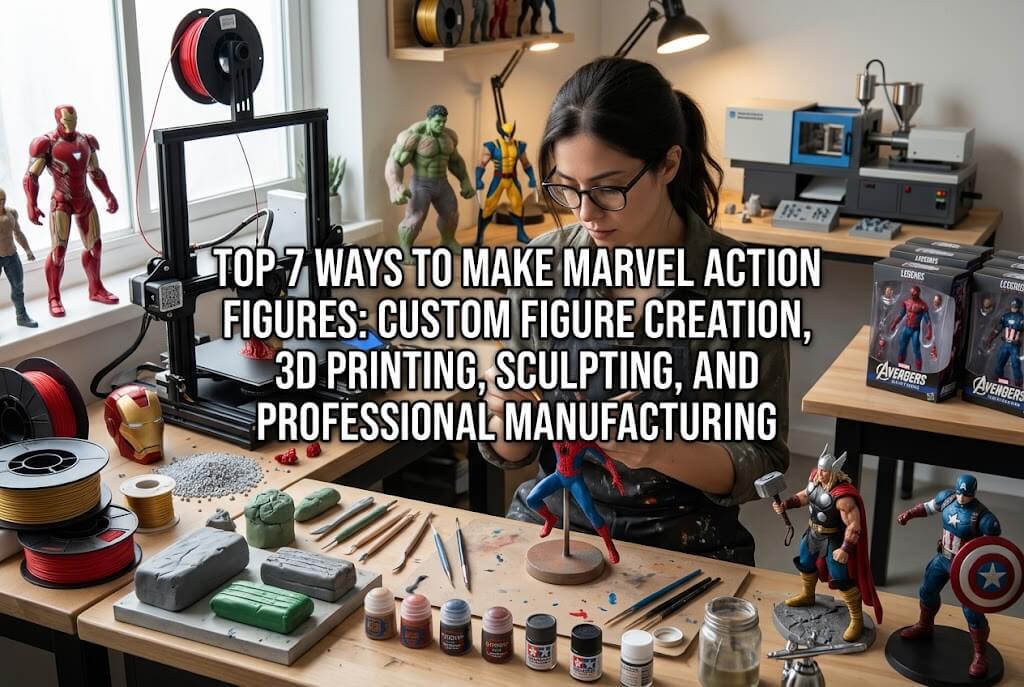
Marvel action figures are among the most recognizable categories in the collectible figure market. From Spider-Man and Iron Man to Wolverine, Deadpool, Thor, Captain America, and Venom, Marvel characters offer a wide range of creative possibilities for figure designers, independent artists, manufacturers, and collectors. Their distinctive costumes, recognizable facial features, armor structures, weapons, and dynamic fighting poses make them particularly interesting subjects for custom figure production.
The popularity of Marvel action figures also comes from the diversity of collectible styles. Some collectors prefer articulated figures that can be displayed in different poses, while others favor premium resin statues with realistic textures and carefully painted details. There is also growing interest in customized characters, alternative costume designs, comic-book interpretations, movie-inspired versions, and personalized superhero collectibles. Market reporting and collectible product listings reflect continued interest in both mainstream Marvel figures and premium collectible formats.
Choosing the right manufacturing method depends on the figure’s intended purpose, production quantity, budget, required articulation, and visual accuracy. Digital sculpting, resin printing, traditional sculpting, kitbashing, repainting, resin casting, and injection molding each offer different advantages. For collectors who want personalized figures without managing the technical production process, Wooxic Figures provides a custom figure service based on customer-uploaded images. A single reference photo is sufficient to begin, without requiring separate side-view or back-view images.
This guide examines seven practical ways to create Marvel action figures, comparing their production processes, preparation materials, advantages, disadvantages, estimated costs, production times, technical difficulty, and achievable detail levels.
Popular Marvel Action Figures Topics and Collectible Trends
Understanding popular Marvel character categories helps determine which designs are worth developing and what manufacturing techniques are most suitable.
|
Popular topic |
Representative characters |
Figure-making opportunities |
|---|---|---|
|
Classic Marvel superheroes |
Spider-Man, Captain America, Thor |
Classic costumes, iconic poses, character collections |
|
Marvel Cinematic Universe |
Iron Man, Doctor Strange, Black Panther |
Movie-inspired costumes, realistic facial details |
|
Armor and mechanical designs |
Iron Man, War Machine, Iron Spider |
Complex armor, mechanical joints, metallic finishes |
|
Mutants and X-Men |
Wolverine, Deadpool, Magneto |
Detailed anatomy, interchangeable accessories |
|
Marvel villains |
Thanos, Venom, Green Goblin, Loki |
Complex facial structures, distinctive textures |
|
Alternative costume versions |
Spider-Man, Wolverine, Captain America |
Multiple costume designs and limited editions |
|
Battle scenes and dioramas |
Avengers, Guardians of the Galaxy |
Multi-character displays and environmental bases |
|
Personalized superhero collectibles |
Custom character interpretations |
Individualized faces, clothing, poses, and accessories |
These topics provide different manufacturing opportunities. For example, Iron Man figures require careful attention to armor segmentation and metallic finishes, while Venom figures demand detailed organic textures and facial structures. Spider-Man collectibles often emphasize articulation and costume patterns, whereas premium Wolverine statues benefit from realistic anatomy and weapon detailing.
1. Photo-Based Custom Figure Production – Wooxic Figures
Photo-based custom figure production is a practical choice for collectors who want an individualized superhero collectible rather than a standard mass-produced action figure. Wooxic Figures offers a custom figure service that develops high-precision figures from customer-submitted photographs or descriptions. Customers only need to upload one suitable reference image to begin the process; separate side-view and back-view photographs are not required. This makes the service particularly convenient for people who want a personalized superhero-inspired collectible but lack professional 3D modeling skills.
Production Steps
The process starts with evaluating the submitted image and identifying important visual characteristics, including facial structure, hairstyle, body proportions, clothing, accessories, and preferred pose. A professional artist then creates a detailed 3D model, interpreting the unseen areas through digital modeling and structural judgment. For a Marvel-inspired design, this stage can incorporate elements such as armored clothing, superhero costumes, distinctive accessories, or personalized character styling, subject to applicable intellectual-property permissions.
After the digital model is developed, a high-detail resin prototype is printed. The printed figure undergoes cleaning, curing, surface refinement, and manual painting. Facial features, clothing colors, metallic details, and small decorative elements receive particular attention. A 3D preview is provided for customer approval before physical production continues, helping identify design adjustments before the final finishing stage.
Pros and Cons
The main advantages are personalization, convenience, and high detail potential. Customers do not need to prepare multiple viewing angles or operate specialized equipment. However, custom production requires more time than purchasing an existing figure, and details that cannot be seen in the reference image must be artistically interpreted. Complex armor or mechanical accessories may also increase production requirements.
Production Cost
An illustrative budget is approximately $100–$400 or more for a one-off custom figure, depending on size, complexity, materials, and finishing requirements. This is not a published Wooxic price quotation.
Production Time
Approximately 2–6 weeks, depending on modeling complexity, preview approval, printing, and painting.
Materials, Difficulty, and Detail
Materials include digital sculpting software, photopolymer resin, high-resolution printing equipment, primer, acrylic paints, and protective coatings. Customer difficulty is low, while production difficulty is advanced. Detail potential is very high, particularly for facial likeness, costume textures, and customized accessories.
2. Digital 3D Sculpting and Resin 3D Printing
Digital sculpting combined with resin 3D printing is one of the most versatile methods for creating highly detailed Marvel action figures. It is particularly suitable for characters with complicated anatomy, intricate costumes, mechanical armor, and distinctive accessories. Iron Man, Doctor Strange, Venom, and Spider-Man are good examples because their designs contain details that benefit from precise digital modeling. Unlike traditional physical sculpting, digital production allows artists to modify proportions, adjust facial expressions, and experiment with different poses without rebuilding the entire physical model.
Production Steps
The process begins with collecting reference images, selecting a character design, and determining the intended figure scale. Artists use specialized 3D sculpting software to construct the head, body, costume, armor, weapons, and accessories. Mechanical characters such as Iron Man may require separately modeled armor plates, while organic characters such as Venom need carefully developed muscles, teeth, and surface textures.
The completed model is divided into printable sections when necessary. Artists then adjust wall thickness, connection points, and support structures using slicing software. Resin printing produces the physical components, which are subsequently washed, cured, sanded, and assembled. A primer layer prepares the surface for painting, followed by acrylic colors, metallic finishes, and protective varnish.
Pros and Cons
The major advantage is exceptional design flexibility and the ability to reproduce small details accurately. Digital files can also be revised and reused for alternative versions. However, professional sculpting requires considerable technical experience, and resin printing introduces additional equipment, maintenance, and safety requirements. Thin accessories and projecting components may also be fragile.
Production Cost
Approximately $30–$200 in printing materials and equipment usage per figure, excluding professional modeling labor and initial equipment investment.
Production Time
Approximately 3–14 days for an experienced creator, depending on model complexity, printing failures, and finishing requirements.
Materials, Difficulty, and Detail
Required materials include a computer, 3D sculpting software, resin printer, photopolymer resin, cleaning supplies, sanding tools, primer, acrylic paints, and varnish. Difficulty is advanced. Detail potential is very high, especially for armor engravings, facial structures, costume textures, and small accessories.
3. Traditional Hand Sculpting with Polymer Clay
Traditional hand sculpting is an established artistic approach for producing original Marvel-inspired collectible figures. Instead of constructing a character entirely through software, the artist builds the physical model directly using polymer clay and specialized sculpting tools. This method is particularly attractive to independent creators who enjoy manual craftsmanship and want complete control over the character’s proportions, facial expressions, and surface appearance. It is suitable for non-articulated display statues, small collectible models, and experimental character designs.
Production Steps
The first stage involves studying character references and preparing a structural armature. A metal wire skeleton is assembled to establish the figure’s posture and provide internal support. Aluminum foil can be added around the structure to create the basic body volume while reducing the amount of clay required.
Polymer clay is then applied gradually, starting with the torso, arms, and legs. Artists refine the anatomy before adding smaller details such as facial features, hair, clothing folds, and accessories. For a Wolverine figure, particular attention should be given to the muscular body, facial expression, and claw proportions. An Iron Man-inspired sculpture requires more precise geometric shaping to reproduce armor surfaces.
Once sculpting is complete, the figure is baked according to the clay manufacturer’s instructions. After cooling, surface imperfections are corrected through sanding and filing. Primer and acrylic paints are applied in thin layers, followed by protective varnish.
Pros and Cons
The main advantage is direct artistic control over the physical sculpture. It also requires relatively little initial equipment compared with professional digital printing. However, symmetrical anatomy, realistic faces, and consistent proportions are difficult to achieve without practice. Thin clay accessories may also break, and manual production is difficult to scale.
Production Cost
Approximately $15–$100 for polymer clay, armature wire, sculpting tools, paints, and finishing materials.
Production Time
Approximately 15–50 hours of active work, usually spread across several days or weeks.
Materials, Difficulty, and Detail
Materials include polymer clay, metal wire, aluminum foil, sculpting tools, a suitable oven, sandpaper, primer, acrylic paints, and varnish. Difficulty is high. Detail potential is high in experienced hands, although complex mechanical structures and extremely small decorative elements require additional precision.
4. Kitbashing Existing Action Figures with Custom Components
Kitbashing involves combining components from existing action figures to create a different character or a customized interpretation. It is a practical technique for Marvel collectors who want to experiment with body proportions, articulation, costumes, and accessories without producing an entire figure from scratch. For example, a creator might combine an existing muscular body, a different head sculpt, custom hands, and separately manufactured accessories to develop a unique superhero collectible.
Production Steps
The process begins with selecting donor figures that provide suitable body proportions and articulation. Their joints, connection points, and physical dimensions must be inspected before disassembly. A custom design plan determines which components will be retained, modified, or replaced.
The selected figures are carefully disassembled using appropriate tools. Depending on the construction, controlled heat may help loosen certain plastic connections. Artists then modify the components using epoxy putty, cutting tools, sanding sticks, and compatible adhesives. Custom armor pieces, clothing details, masks, or weapons can be created separately using sculpting materials or 3D-printed parts.
Once the components fit together, the figure undergoes test assembly to check proportions and joint movement. Surface preparation follows, including mold-line removal, sanding, and priming. The final stage involves repainting, applying small decorative details, assembling accessories, and adding protective coatings.
Pros and Cons
Kitbashing is more affordable than creating an entire figure from scratch and preserves the articulation of suitable donor figures. It also allows experimentation with different designs. However, compatibility between components can be difficult, and the original figure’s proportions may restrict the final appearance. Cutting and modifying existing parts can also permanently damage valuable collectibles.
Production Cost
Approximately $30–$150, depending on donor figures, replacement components, sculpting materials, and paint requirements.
Production Time
Approximately 5–20 days, depending on modification complexity and the number of components involved.
Materials, Difficulty, and Detail
Materials include donor figures, epoxy putty, hobby knives, sanding tools, adhesives, primer, acrylic paints, and replacement accessories. Difficulty is intermediate to advanced. Detail potential is high, although the final result depends heavily on donor-component quality and assembly precision.
5. Repainting and Surface Detailing of Commercial Marvel Figures
Repainting existing commercial action figures is an accessible way to improve their visual appearance without manufacturing a completely new sculpt. This technique is especially useful for collectors who want more realistic skin tones, deeper shadows, improved costume colors, or enhanced metallic surfaces. Characters such as Iron Man, Black Panther, Spider-Man, and Captain America provide interesting opportunities because their recognizable designs depend heavily on color separation, surface finishing, and small decorative details.
Production Steps
The process starts with selecting an existing figure that has suitable proportions and a well-defined sculpt. The original paintwork is inspected to identify areas requiring correction. When necessary, removable components are separated to make detailed painting easier. The surface is cleaned to remove dust, oils, and residue that could interfere with paint adhesion.
A compatible primer is applied before the main color layers. Artists then use acrylic paints, fine brushes, or an airbrush to improve the character’s appearance. Iron Man figures may benefit from carefully layered metallic red and gold finishes, while Spider-Man figures require precise separation between costume colors and web patterns. Black Panther figures can receive subtle gray highlights to emphasize sculpted suit textures.
After the base colors are completed, additional shading, highlights, and fine details are applied. A suitable matte, satin, or gloss protective coating is selected according to the desired appearance. Final inspection checks paint consistency, surface cleanliness, and whether the joints remain functional.
Pros and Cons
The main benefits are relatively low cost, short production time, and the ability to improve existing collectibles. However, repainting cannot fundamentally change the original sculpt. Poor paint compatibility may cause peeling, while thick coatings can obscure fine details or interfere with articulation.
Production Cost
Approximately $20–$100, including paints, primer, brushes, cleaning materials, and finishing coatings, excluding the original figure.
Production Time
Approximately 1–7 days, depending on the number of colors and level of detailing.
Materials, Difficulty, and Detail
Materials include acrylic paints, primer, brushes, airbrush equipment, masking tape, cleaning supplies, and varnish. Difficulty is beginner to intermediate. Detail restoration is moderate to high, with excellent results possible when the original sculpt is already well developed.
6. Silicone Mold Making and Resin Casting
Silicone mold making and resin casting are suitable for creators who want to reproduce an existing Marvel-inspired figure design in multiple copies. This technique is commonly used for limited-edition collectibles, small independent production runs, and detailed display statues. It is particularly useful when a sculptor has already developed a master model and wants to reproduce the same character without repeating the entire sculpting process. Designs featuring detailed facial expressions, muscular anatomy, armor decorations, and small accessories can benefit from properly prepared silicone molds.
Production Steps
The process begins with creating a master figure through traditional sculpting or digital 3D printing. The master is inspected, sanded, and prepared to ensure that its surface details are suitable for reproduction. A mold box is then constructed around the model, and liquid silicone is poured carefully to capture its geometry. Depending on the figure’s shape, a multi-part mold may be necessary to accommodate undercuts and complicated accessories.
After the silicone cures, the master is removed and the mold is inspected for imperfections. Two-part casting resin is measured and mixed according to the manufacturer’s specifications. The mixture is poured into the mold, with vacuum degassing or pressure casting used when appropriate to minimize bubbles. After curing, the components are removed, trimmed, sanded, and assembled.
The final stage involves priming, painting, and protective finishing. Metallic paints can reproduce Iron Man-inspired armor, while darker layered finishes can emphasize the textures of Venom-inspired statues.
Pros and Cons
The main advantage is repeatable production with good surface-detail reproduction. It can reduce the labor required for small production batches. However, silicone molds have limited service lives, and casting defects such as bubbles, incomplete filling, and seam lines can affect quality. Initial mold preparation also requires time and materials.
Production Cost
Approximately $50–$300 for a small master-and-mold project, excluding extensive professional sculpting labor.
Production Time
Approximately 3–10 days for initial mold preparation, casting, and finishing, depending on complexity.
Materials, Difficulty, and Detail
Materials include a master figure, silicone rubber, casting resin, mold boxes, release agents, mixing equipment, protective gear, sanding tools, primer, and paints. Difficulty is advanced. Detail potential is very high when the master and mold are properly prepared.
7. PVC and ABS Injection Molding for Commercial Marvel Action Figures
Injection molding is a widely used industrial manufacturing method for producing large quantities of plastic action figure components. It is particularly suitable for established collectible brands and manufacturers developing commercial superhero figure lines. Unlike individual resin printing or hand sculpting, injection molding is designed to produce consistent components repeatedly. It is therefore an appropriate choice for businesses planning substantial production quantities rather than collectors who need only one customized figure.
Production Steps
The process starts with a production-ready digital design. Engineers determine the figure’s dimensions, articulation system, material requirements, component structure, and assembly connections. The design is divided into moldable parts, including the head, torso, arms, legs, hands, armor, and accessories. Joint tolerances and wall thickness must be carefully considered to ensure that the finished figure can withstand repeated movement.
A physical prototype is developed to evaluate proportions, appearance, and articulation before tooling is approved. Manufacturers then produce precision molds using suitable industrial tooling materials. PVC, ABS, or other compatible plastics are heated and injected into the mold under controlled pressure. Once cooled and solidified, individual components are removed and inspected.
The components subsequently undergo trimming, painting, pad printing, or other decorative processes. Assembly teams install the joints and accessories, while quality-control staff inspect paint consistency, structural strength, articulation, and packaging.
Pros and Cons
The biggest advantage is manufacturing consistency and relatively low unit costs at sufficient production volumes. Injection molding also supports durable articulated structures and interchangeable accessories. However, tooling investment is substantial, development takes considerably longer than custom resin production, and design changes after mold manufacturing can be expensive.
Production Cost
Initial tooling and development can cost several thousand to tens of thousands of dollars or more, depending on figure complexity and the number of molds. Individual production costs depend on material, order quantity, decoration, assembly, and packaging.
Production Time
Approximately 2–6 months for design, prototyping, tooling, testing, and commercial production preparation.
Materials, Difficulty, and Detail
Materials include PVC, ABS, industrial mold tooling, pigments, printing materials, assembly components, and protective packaging. Difficulty is very high because specialized engineering and factory equipment are required. Detail potential is very high, although intricate facial features and costume patterns may require additional printing or hand finishing.
Comparison of the Seven Marvel Action Figure Manufacturing Methods
The following table compares the seven production approaches according to detail reproduction, customization flexibility, difficulty, and cost efficiency. These ratings are practical comparative assessments rather than standardized manufacturing measurements.
|
Manufacturing method |
Detail accuracy |
Customization |
Difficulty |
Cost efficiency |
|---|---|---|---|---|
|
Wooxic photo-based custom production |
★★★★★ |
★★★★★ |
★★★★☆ |
★★★★☆ |
|
Digital sculpting and resin printing |
★★★★★ |
★★★★★ |
★★★★☆ |
★★★★☆ |
|
Traditional polymer clay sculpting |
★★★★☆ |
★★★★★ |
★★★★★ |
★★★★☆ |
|
Kitbashing existing action figures |
★★★★☆ |
★★★★☆ |
★★★☆☆ |
★★★★☆ |
|
Repainting commercial figures |
★★★☆☆ |
★★★☆☆ |
★★☆☆☆ |
★★★★★ |
|
Silicone molding and resin casting |
★★★★★ |
★★★★☆ |
★★★★☆ |
★★★★☆ |
|
PVC and ABS injection molding |
★★★★☆ |
★★★☆☆ |
★★★★★ |
★★★★★ at scale |
Cost efficiency is dependent on production quantity. Injection molding has high initial investment but becomes more economical at scale. Photo-based customization is more appropriate for individual personalized orders.
How to Choose the Best Marvel Action Figure Production Method
Selecting a manufacturing technique should start with identifying the intended product and target collector.
For personalized collectibles, photo-based custom production is a practical choice. Wooxic Figures is particularly relevant because customers can begin with just one reference photograph, without preparing separate side and back views. The service combines digital 3D modeling, high-detail resin printing, and hand painting to develop customized figures.
For independent artists who want complete control over character design, digital sculpting and resin printing provide greater flexibility. Traditional sculpting is another option for creators who prefer manual craftsmanship and original artistic interpretations.
For collectors who already own commercial figures, kitbashing and repainting offer relatively affordable customization opportunities. Silicone casting is more suitable for limited production runs, while injection molding is better suited to commercial manufacturers with sufficient production volume.
It is also important to distinguish between articulated action figures and non-articulated display statues. A highly detailed resin statue may deliver excellent visual accuracy but may not withstand repeated movement. Conversely, a commercial articulated figure may prioritize mechanical durability over extremely fine surface details.
Producing high-quality Marvel action figures requires a balance between character accuracy, material selection, structural durability, and finishing quality. Different characters also create different manufacturing challenges. Iron Man requires accurate armor geometry and metallic finishes, Spider-Man benefits from precise costume patterns and articulation, Wolverine requires convincing anatomy and accessory details, while Venom demands complex facial structures and organic surface textures.
Digital sculpting and resin printing are particularly effective for detailed custom designs, whereas injection molding is more appropriate for large-scale commercial production. Traditional sculpting, kitbashing, repainting, and resin casting each provide practical alternatives for different budgets and creative requirements.
For collectors seeking personalized superhero-inspired figures, Wooxic Figures offers a convenient approach to custom production. Customers can submit a single photograph without needing additional side-view or back-view images. The production team develops a 3D model, creates a high-detail resin figure, and applies manual painting to achieve the intended appearance. This approach reduces the technical preparation required from customers while allowing greater flexibility than selecting a standard retail collectible.
The best Marvel action figures are not necessarily those produced using the most expensive manufacturing equipment. Their quality depends on how effectively the production process translates the original character design into a durable, visually accurate collectible. By choosing an appropriate method for the intended character, production quantity, and finishing requirements, artists and collectors can create distinctive Marvel action figures that combine craftsmanship, customization, and long-term display value.