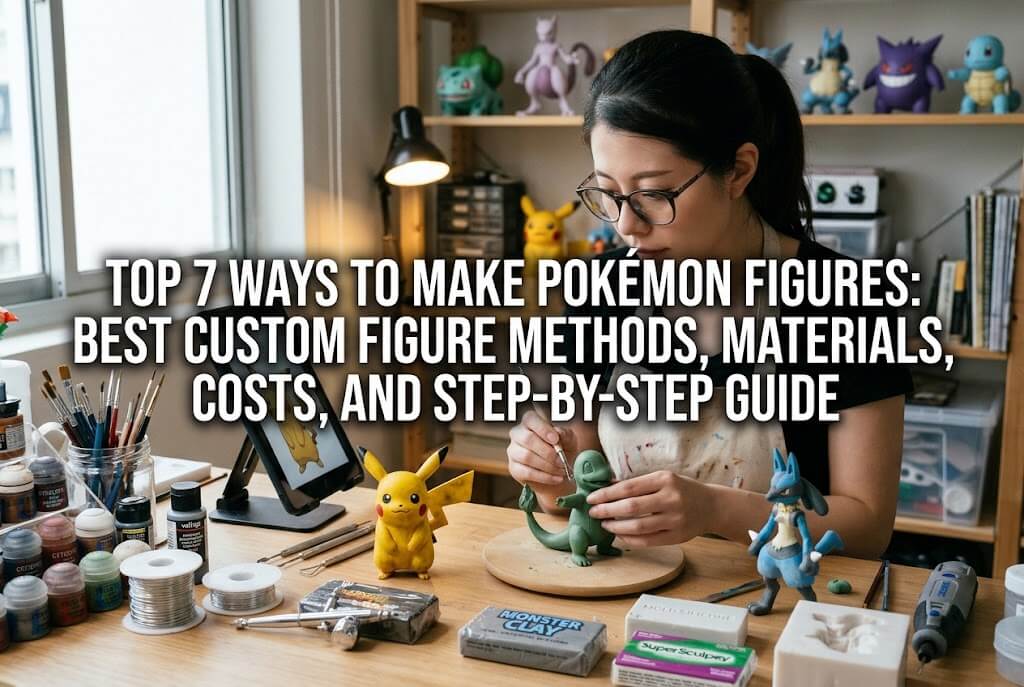
Pokémon figures are among the most recognizable categories in the character collectible market. From the iconic Pikachu and Charizard to Eevee and its evolutions, Mewtwo, Lucario, Gengar, and legendary Pokémon, these characters offer extensive opportunities for figure designers, independent artists, manufacturers, and collectors. Their distinctive body proportions, facial expressions, colors, textures, and special abilities create different challenges for figure production. Unlike realistic human figures, Pokémon collectibles often require artists to reproduce stylized anatomy accurately while maintaining the original character’s recognizable personality.
The Pokémon collectible market covers several different product categories, including miniature PVC figures, articulated action figures, resin statues, soft vinyl toys, model kits, and premium display collectibles. Popular creative directions include starter Pokémon collections, legendary Pokémon statues, evolution-themed displays, shiny Pokémon variants, battle-scene dioramas, and customized character interpretations. Pikachu, Charizard, Mewtwo, and other recognizable characters have also demonstrated strong collector interest across different merchandise categories.
There are several ways to manufacture Pokémon figures, depending on the character’s complexity, desired dimensions, production quantity, budget, and finishing requirements. Digital sculpting and resin printing provide excellent design flexibility, while traditional sculpting offers direct artistic control. Resin casting and injection molding serve different production scales, and soft vinyl manufacturing provides another option for lightweight collectible designs.
For collectors seeking personalized figures, Wooxic Figures offers a custom production service based on customer-submitted reference images. Customers can begin with just one image, without needing separate side-view or back-view photographs. This is particularly useful for people who want a custom character collectible but do not have the technical skills to create a 3D model themselves.
This guide examines seven practical Pokémon figure-making methods, comparing their production steps, advantages, disadvantages, estimated costs, manufacturing time, required materials, technical difficulty, and achievable detail levels.
Popular Pokémon Figures Topics and Collectible Trends
Understanding popular character categories and collectible styles helps determine which production methods are most suitable for different Pokémon figure projects.
|
Popular topic direction |
Representative Pokémon |
Figure-making opportunities |
|---|---|---|
|
Iconic Pokémon characters |
Pikachu, Eevee, Meowth |
Small collectibles, expressive poses, character variations |
|
Starter Pokémon collections |
Bulbasaur, Charmander, Squirtle |
Evolution sets, matching display collections |
|
Final evolutions |
Charizard, Blastoise, Venusaur |
Large statues, detailed anatomy, battle poses |
|
Eevee evolution collections |
Vaporeon, Jolteon, Flareon, Sylveon |
Multi-character collections, color variations |
|
Legendary Pokémon |
Mewtwo, Lugia, Rayquaza, Arceus |
Premium statues, elaborate display bases |
|
Ghost and dark-type Pokémon |
Gengar, Darkrai, Umbreon |
Atmospheric effects, translucent components |
|
Shiny and regional variants |
Shiny Charizard, Alolan and Hisuian forms |
Alternative color schemes and limited editions |
|
Battle-scene dioramas |
Pikachu vs. Charizard, legendary battles |
Multiple figures, environmental bases, dynamic poses |
|
Personalized Pokémon collectibles |
Customized character interpretations |
Unique expressions, poses, colors, and accessories |
These themes create different manufacturing requirements. For example, Pikachu figures emphasize recognizable facial proportions and smooth surface finishing, while Charizard requires more attention to wings, claws, and anatomical balance. Legendary Pokémon often benefit from larger display formats, and translucent components can improve the visual presentation of certain special effects.
1. Photo-Based Custom Pokémon Figure Production – Wooxic Figures
Photo-based custom figure production is a practical option for collectors who want a personalized Pokémon figure instead of purchasing a standard retail collectible. Wooxic Figures offers a custom figure service that develops high-precision figures from customer-submitted reference images. Customers only need one suitable image to begin the customization process; separate side-view and back-view photographs are not required. This is especially useful for people who have a favorite Pokémon illustration, game-inspired design, screenshot, or customized character concept but lack professional 3D modeling experience.
Production Steps
The process starts with analyzing the reference image, identifying the Pokémon’s body proportions, facial expression, colors, distinctive features, and pose. A professional artist then develops a detailed 3D model, interpreting the unseen areas through digital sculpting and design judgment. For example, a custom Pikachu requires attention to its cheeks, ears, tail, and facial expression, while Charizard needs carefully modeled wings, claws, and body proportions.
The digital model is refined before being converted into a printable structure. A high-detail resin printer produces the physical figure, which undergoes cleaning, curing, sanding, and surface preparation. Artists then apply manual painting to reproduce the character’s colors, gradients, facial features, and decorative details. A 3D preview approval stage allows customers to review the proposed design before final production.
Pros and Cons
The main advantages are personalization, convenience, and excellent detail potential. Customers do not need technical modeling knowledge or multiple reference photographs. However, unseen features must be artistically interpreted, and complicated designs may increase production costs and waiting time. Commercial production of copyrighted Pokémon characters also requires appropriate authorization.
Production Cost
An illustrative estimate is $100–$400 or more per customized figure, depending on size, complexity, materials, and finishing. This is not a published Wooxic quotation.
Production Time
Approximately 2–6 weeks, depending on modeling, approval, printing, and painting.
Materials, Difficulty, and Detail
Materials include digital sculpting software, photopolymer resin, high-resolution printers, primer, acrylic paints, and protective coatings. Customer difficulty is low, while production difficulty is advanced. Detail restoration is very high, particularly for facial expressions, character proportions, and small decorative features.
2. Digital 3D Sculpting and Resin 3D Printing
Digital sculpting combined with resin 3D printing is one of the most versatile methods for producing highly detailed Pokémon figures. It is especially suitable for characters with distinctive anatomy, complicated accessories, and elaborate poses. Compared with traditional sculpting, digital modeling makes it easier to modify proportions, adjust facial expressions, and develop alternative character versions. It is particularly useful for creating premium Charizard statues, detailed Mewtwo figures, and customized legendary Pokémon collectibles.
Production Steps
The process begins with collecting reference images and determining the figure’s dimensions, pose, and intended display format. Artists use specialized sculpting software to construct the character’s head, body, limbs, tail, wings, and other distinguishing features. Small details such as Pikachu’s facial markings, Charizard’s claws, or Lucario’s facial structures are refined individually.
Once the model is completed, it is checked for structural strength and divided into separate components when necessary. Slicing software prepares the model for printing by generating support structures and optimizing component orientation. High-resolution resin printing produces the physical parts, which are washed, cured, sanded, and assembled. Primer is applied before painting, followed by detailed color layers and protective varnish.
Pros and Cons
The main advantages are excellent detail reproduction, flexible design modifications, and reusable digital files. However, professional sculpting requires experience, while printing equipment and resin materials introduce additional costs. Thin accessories, ears, and tails may also become fragile if incorrectly designed.
Production Cost
Approximately $30–$200 in printing materials and equipment usage per small or medium figure, excluding professional modeling labor and initial equipment investment.
Production Time
Approximately 3–14 days for an experienced creator, depending on modeling complexity, printing quality, and finishing.
Materials, Difficulty, and Detail
Materials include a computer, 3D sculpting software, resin printer, photopolymer resin, cleaning supplies, sanding tools, primer, acrylic paints, and varnish. Difficulty is advanced. Detail restoration is very high, particularly for facial features, surface textures, body proportions, and small accessories.
3. Traditional Hand Sculpting with Polymer Clay
Traditional hand sculpting is an artistic production method that allows creators to build Pokémon figures directly from physical modeling materials. It is particularly attractive to independent artists and hobbyists who prefer manual craftsmanship and want to develop original character interpretations. This method is suitable for small display figures, handmade collectibles, and experimental designs where artistic expression is more important than manufacturing consistency.
Production Steps
The process begins with studying the character’s reference images and establishing its proportions. A wire armature is prepared for figures with extended limbs, large tails, or complicated poses. Aluminum foil can be added to establish the basic body volume and reduce the amount of clay required.
Polymer clay is applied gradually, starting with the main body before adding the head, limbs, facial features, and accessories. Artists use sculpting tools to refine the characteristic features of each Pokémon. For example, Eevee requires carefully shaped ears and fur details, while Bulbasaur needs an accurately proportioned body and a recognizable plant bulb. Once the sculpture is complete, it is baked according to the manufacturer’s temperature and curing instructions.
After cooling, the surface is refined using sanding tools and files. Primer creates a suitable painting surface, while acrylic paints reproduce the character’s color scheme. Small details are applied with fine brushes before the final protective coating.
Pros and Cons
The main advantage is direct artistic control over shape, proportions, and surface details. Initial equipment costs are relatively low, and each figure can have a distinctive handmade appearance. However, producing consistent proportions requires practice, while complicated anatomical structures can be difficult to reproduce. Thin clay components may also break during handling.
Production Cost
Approximately $15–$100 for clay, armature wire, sculpting tools, paints, and finishing materials.
Production Time
Approximately 15–50 hours of active work, usually spread across several days or weeks.
Materials, Difficulty, and Detail
Materials include polymer clay, metal wire, aluminum foil, sculpting tools, a suitable oven, sandpaper, primer, acrylic paints, and varnish. Difficulty is high for realistic character reproduction. Detail restoration is high when performed by experienced artists, particularly for facial expressions, fur textures, and distinctive body structures.
4. Silicone Mold Making and Resin Casting
Silicone mold making and resin casting are suitable for producing multiple copies of an established Pokémon figure design. This method is particularly useful for independent collectible studios, limited-edition releases, and small production batches. Rather than sculpting every figure individually, manufacturers create a master model and reproduce it through flexible silicone molds. Resin casting is especially effective for detailed display figures featuring complex shapes, textured surfaces, and separate decorative components.
Production Steps
The process begins with preparing a master model, which can be created through traditional sculpting or digital 3D printing. The master is carefully sanded and inspected to ensure that its surface details are suitable for reproduction. It is then positioned inside a mold box, and liquid silicone is poured around it to capture the character’s geometry. Complicated figures may require multiple mold sections to accommodate undercuts and projecting features.
After the silicone has cured, the master is removed and the mold is inspected. Two-part polyurethane casting resin is measured and mixed according to the manufacturer’s specifications before being poured into the mold. Vacuum degassing or pressure casting can reduce air bubbles, especially around small facial features and delicate accessories.
Once cured, the resin components are removed, trimmed, and sanded. Separate sections are assembled where necessary, followed by primer application and manual painting. Color gradients, facial markings, and small decorative details are added before protective varnish completes the figure.
Pros and Cons
The main advantages are good surface-detail reproduction and the ability to reproduce an established design without repeating the complete sculpting process. It is suitable for limited production runs. However, silicone molds gradually wear out, casting may produce bubbles or seam lines, and resin components can be relatively heavy or fragile.
Production Cost
Approximately $50–$300 for a small master-and-mold project, excluding substantial professional sculpting labor and specialized equipment.
Production Time
Approximately 3–10 days for initial mold preparation, casting, and finishing.
Materials, Difficulty, and Detail
Materials include a master figure, silicone rubber, casting resin, mold boxes, release agents, mixing containers, protective equipment, sanding tools, primer, and paints. Difficulty is advanced. Detail restoration is very high, especially for facial structures, small decorative elements, and intricate character surfaces.
5. PVC and ABS Injection Molding for Commercial Pokémon Figures
PVC and ABS injection molding are widely used industrial manufacturing methods for producing collectible figures in substantial quantities. They are particularly suitable for businesses developing commercial Pokémon figure collections, miniature character series, and articulated products. Unlike individual resin printing, injection molding focuses on manufacturing consistency and repeatability. Although tooling requires significant initial investment, the cost per figure can become more economical when production quantities are sufficiently large.
Production Steps
The process starts with developing a manufacturing-ready 3D design. Engineers determine the figure’s dimensions, component structure, material requirements, and assembly specifications. Characters with complicated shapes, such as Charizard with its wings and tail or Lugia with its extended body structures, may require multiple separate mold components.
A prototype is produced to evaluate proportions, surface quality, stability, and assembly requirements. After the design is approved, precision molds are manufactured. PVC or ABS plastic pellets are heated and injected into the molds under controlled pressure. Once the material cools and solidifies, the components are removed and inspected.
The next stage involves trimming excess material, checking dimensional accuracy, and preparing the surfaces for decoration. Automated spraying, pad printing, and manual painting can reproduce character colors and small visual features. Components are then assembled, inspected, and packaged. For licensed commercial products, design approvals and applicable toy-safety requirements must also be addressed.
Pros and Cons
The main advantages are consistent dimensions, repeatable quality, and relatively low unit costs at higher production volumes. Injection molding also supports durable plastic structures and articulated components. However, tooling is expensive, development takes considerable time, and changing the design after mold manufacturing can be costly.
Production Cost
Initial tooling may cost several thousand to tens of thousands of dollars or more, depending on mold complexity and component quantity. Individual unit costs depend on materials, production volume, decoration, and packaging.
Production Time
Approximately 3–8 months for design, prototyping, tooling, testing, and commercial production preparation.
Materials, Difficulty, and Detail
Materials include PVC, ABS, metal tooling, pigments, printing materials, assembly components, and packaging. Difficulty is very high because industrial equipment and engineering expertise are required. Detail restoration is high to very high, particularly when additional printing and manual finishing are used.
6. Soft Vinyl Figure Manufacturing and Rotational Molding
Soft vinyl manufacturing is a distinctive method for creating lightweight Pokémon collectibles with a slightly flexible, hollow structure. It is particularly suitable for stylized figures, designer-inspired collectibles, oversized character models, and limited-edition releases. Compared with solid resin statues, hollow vinyl figures are generally lighter and can accommodate larger dimensions without requiring the same amount of material. This approach is also useful for producing simplified Pokémon interpretations with distinctive color schemes and smooth surfaces.
Production Steps
The process begins with creating a master sculpture that defines the character’s overall proportions and surface features. A metal mold is then prepared according to the approved design. Liquid PVC-based vinyl material is introduced into the mold, which is rotated while heated so that the material forms an even layer along the internal surface.
Once the required wall thickness has developed, excess material is removed and the mold undergoes controlled cooling. The hollow vinyl shell is then extracted and inspected for deformation, surface defects, and inconsistent thickness. Separate components, such as heads, ears, limbs, and tails, may be produced individually and assembled afterward.
The finishing stage involves trimming connection edges, preparing the surface, and applying the character’s color scheme. Artists may use spray painting, masking, gradients, and hand-painted details to reproduce recognizable Pokémon features. A final inspection checks component connections, paint consistency, and structural quality.
Pros and Cons
Soft vinyl offers lightweight construction, relatively large display possibilities, and distinctive collectible appeal. It also supports creative color variations and stylized character designs. However, specialized molds and heating equipment are required. Fine details may be less economical to reproduce than with resin printing, and uneven wall thickness can affect durability.
Production Cost
Approximately $100–$500 or more for prototype and initial mold-related work, depending on size, design complexity, and manufacturing arrangements.
Production Time
Approximately 3–8 weeks for sculpting, mold preparation, vinyl production, painting, and assembly.
Materials, Difficulty, and Detail
Materials include a master sculpture, soft vinyl compound, metal molds, heating equipment, trimming tools, pigments, spray paints, and protective coatings. Difficulty is very high at the factory level. Detail restoration is high for silhouettes, facial features, and larger surface textures, although extremely fine details generally favor resin manufacturing.
7. Existing Pokémon Figure Customization and Repainting
Customizing existing Pokémon figures is an accessible method for collectors who want a distinctive collectible without manufacturing a completely new character from scratch. It is particularly suitable for repainting standard retail figures, creating alternative color versions, improving surface finishes, or developing personalized display arrangements. This method is also useful for artists who want to practice painting techniques before investing in professional sculpting equipment or digital modeling software.
Production Steps
The process begins with selecting an existing figure that has suitable proportions and a well-defined sculpt. Its original paintwork, surface condition, and component connections are inspected before deciding which modifications are practical. Removable parts are separated when possible, making detailed painting and cleaning easier.
The surface is cleaned and prepared using materials compatible with the original plastic. A suitable primer is applied before introducing new colors. Artists can use acrylic paints, fine brushes, or airbrush equipment to create alternative character appearances. For example, a shiny Pokémon-inspired design may require carefully adjusted color tones, while a metallic Mewtwo interpretation can benefit from layered metallic finishes and subtle shading.
Additional modifications may include custom display bases, decorative accessories, or separately manufactured components. Once painting is complete, the figure receives an appropriate protective coating. The final stage involves reassembly and inspection to ensure that the new finish does not interfere with joints or other moving parts.
Pros and Cons
The main advantages are low initial investment, relatively short production time, and accessibility for beginners. It is also possible to experiment with alternative character designs without producing an entirely new sculpture. However, customization is limited by the original figure’s anatomy and geometry. Major changes to body proportions or facial structures require more extensive reconstruction.
Production Cost
Approximately $20–$120, including the original figure, paints, primer, brushes, cleaning materials, and protective coatings.
Production Time
Approximately 1–7 days, depending on the complexity of the repainting and additional modifications.
Materials, Difficulty, and Detail
Materials include an existing figure, acrylic paints, primer, fine brushes, airbrush equipment, masking tape, compatible cleaning materials, and varnish. Difficulty ranges from beginner to intermediate. Detail restoration is moderate to high, although the final result remains dependent on the quality of the original sculpt.
Comparison of the Seven Pokémon Figure Manufacturing Methods
The following table compares the seven production methods according to detail reproduction, customization flexibility, technical difficulty, and cost efficiency. The ratings are comparative assessments rather than standardized industry measurements.
|
Manufacturing method |
Detail restoration |
Customization |
Difficulty |
Cost efficiency |
|---|---|---|---|---|
|
Wooxic photo-based customization |
★★★★★ |
★★★★★ |
★★★★☆ |
★★★★☆ |
|
Digital sculpting and resin printing |
★★★★★ |
★★★★★ |
★★★★☆ |
★★★★☆ |
|
Traditional polymer clay sculpting |
★★★★☆ |
★★★★★ |
★★★★★ |
★★★★☆ |
|
Silicone mold and resin casting |
★★★★★ |
★★★★☆ |
★★★★☆ |
★★★★☆ |
|
PVC and ABS injection molding |
★★★★☆ |
★★★☆☆ |
★★★★★ |
★★★★★ at scale |
|
Soft vinyl manufacturing |
★★★★☆ |
★★★★☆ |
★★★★★ |
★★★★☆ |
|
Existing figure customization |
★★★☆☆ |
★★★☆☆ |
★★☆☆☆ |
★★★★★ |
Cost efficiency depends on production quantity. Injection molding is more economical for large commercial orders, while resin printing and custom sculpting are better suited to individual figures and limited production runs.
How to Choose the Best Pokémon Figure Manufacturing Method
Choosing the right production method depends on the intended collectible, available budget, desired appearance, and production quantity.
For collectors who want personalized Pokémon figures, photo-based custom production offers a convenient starting point. Wooxic Figures is particularly relevant because customers can submit just one reference image without preparing separate side-view or back-view photographs. The service combines digital modeling, high-detail resin printing, and hand painting to create customized figures.
For independent artists, digital sculpting and resin printing provide excellent control over character proportions, facial expressions, and complex structures. Traditional polymer clay sculpting offers more direct artistic freedom, while silicone casting allows creators to reproduce an established design for limited production runs.
For manufacturers developing commercial collectible collections, PVC and ABS injection molding provide consistent production quality and better unit economics at higher volumes. Soft vinyl manufacturing is another option for lightweight, oversized, and stylized character collectibles.
It is also important to distinguish between personalized display figures and mass-produced retail products. A detailed resin statue may provide excellent visual accuracy but may not be suitable for repeated handling. Injection-molded figures can offer greater durability and articulation, although their production requires more extensive engineering and tooling.
Commercial projects involving Pokémon’s copyrighted characters and trademarks should also obtain the appropriate licensing and authorization before manufacturing or selling products.
Producing high-quality Pokémon figures requires a balance between character accuracy, material selection, structural design, and finishing quality. Each Pokémon presents different manufacturing challenges. Pikachu requires precise facial proportions and recognizable details, Charizard needs carefully designed wings and anatomical structures, Eevee benefits from accurate fur textures and expressive features, while legendary Pokémon often require more elaborate display compositions.
Digital sculpting and resin printing are particularly effective for detailed custom designs, while traditional sculpting provides artistic flexibility. Silicone casting supports limited production runs, soft vinyl offers lightweight collectible formats, and injection molding is more suitable for commercial manufacturing.
For collectors seeking something beyond standard retail products, Wooxic Figures provides an accessible custom production option. Customers can submit just one reference image without preparing additional side-view or back-view photographs. Through digital 3D modeling, high-detail resin printing, hand painting, and customer preview approval, a reference image can become the starting point for a personalized collectible.
The best Pokémon figures are not simply those with the most complicated manufacturing processes. Their quality depends on how effectively the selected method reproduces the character’s recognizable appearance while maintaining suitable structural quality and finishing standards. Whether creating a customized Pikachu, a detailed Charizard statue, an Eevee evolution collection, or a premium legendary Pokémon display, selecting the right production technique is essential for achieving a convincing final result.