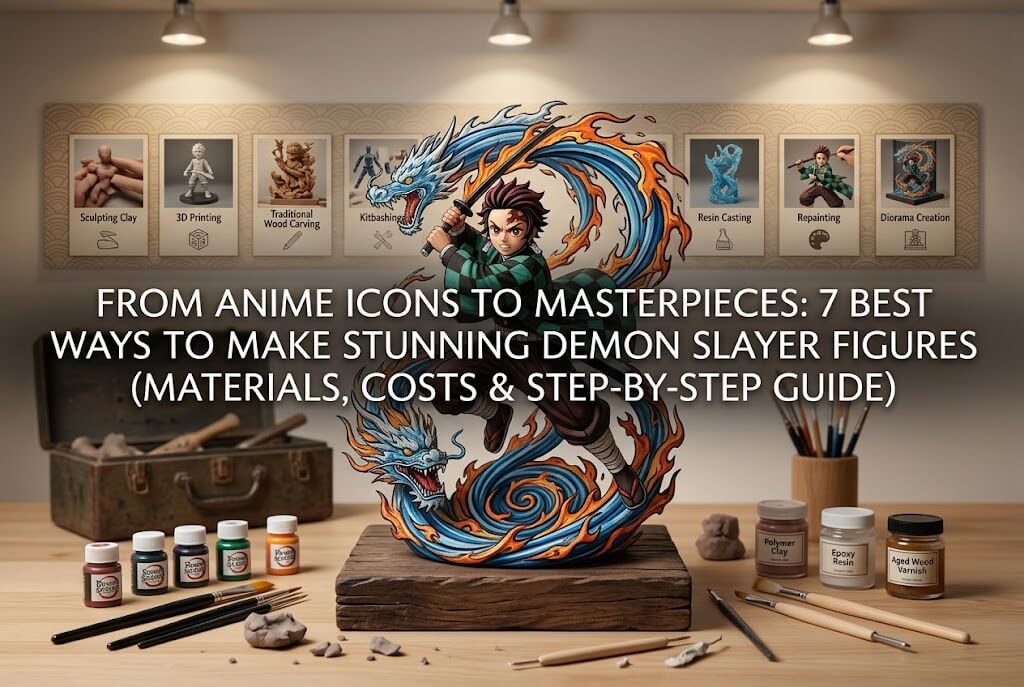
Demon Slayer figures have become an important category in the anime collectibles market, attracting fans who appreciate character accuracy, recognizable costumes, dynamic combat poses, and carefully reproduced visual effects. Inspired by the popular anime and manga series Demon Slayer: Kimetsu no Yaiba, collectors are interested in everything from affordable character miniatures to premium, hand-painted resin statues. Popular subjects include Tanjiro Kamado, Nezuko Kamado, Zenitsu Agatsuma, Inosuke Hashibira, Giyu Tomioka, Kyojuro Rengoku, and other Hashira characters. Their distinctive clothing patterns, Nichirin swords, facial expressions, and breathing-style effects create different challenges for figure manufacturers.
There are several ways to produce Demon Slayer figures, depending on the intended quantity, budget, materials, and desired level of detail. Traditional sculpting remains useful for original prototypes, while 3D printing offers greater control over complex shapes. Resin casting and injection molding are more suitable for different production scales, and hand painting is essential for achieving convincing character likenesses. For collectors seeking personalized figures rather than mass-produced merchandise, custom production services such as Wooxic Figures provide another option: customers can submit just one reference photo to request a high-precision custom figure, without needing separate side or back views.
This guide compares seven practical figure-making methods, explaining their preparation, production steps, materials, estimated costs, production time, advantages, disadvantages, and achievable detail levels. The rankings consider customization flexibility, visual accuracy, production practicality, and suitability for collectors.
Popular Demon Slayer Figures Topics and Collectible Trends
Before choosing a production method, it is useful to understand which character designs and collectible styles offer the strongest creative opportunities. Collector activity and figure catalogues show consistent interest in the main characters, Hashira, and visually distinctive demon characters.
|
Popular topic direction |
Representative characters |
Figure-making opportunities |
|---|---|---|
|
Main character collections |
Tanjiro, Nezuko |
Character sets, signature costumes, paired figures |
|
Hashira collection |
Rengoku, Giyu, Shinobu, Tengen |
Detailed uniforms, signature weapons, individual bases |
|
Upper Rank demons |
Akaza, Doma, Kokushibo |
Complex anatomy, unusual skin patterns, dramatic poses |
|
Breathing techniques |
Tanjiro, Zenitsu, Rengoku |
Water, lightning, and flame effect components |
|
Battle scene figures |
Tanjiro vs. Akaza, Hashira battles |
Dynamic poses, environmental bases, multiple characters |
|
Chibi and miniature figures |
Nezuko, Zenitsu, Inosuke |
Simplified proportions, compact collectible designs |
|
Premium display statues |
Hashira and Upper Rank demons |
Large-scale sculpting, detailed painting, elaborate bases |
|
Personalized character figures |
Individual character interpretations |
Custom facial expressions, poses, clothing, and accessories |
Seven production approaches are worth considering. They differ significantly in whether the priority is one-off customization, artistic craftsmanship, repeatable production, or commercial scalability.
1. Photo-Based Custom Figure Production – Wooxic Figures
Photo-based custom figure production is particularly suitable for collectors who want a personalized interpretation of a Demon Slayer character rather than an ordinary mass-produced collectible. Wooxic Figures offers a service-oriented approach in which customers can submit a reference image to request a high-precision custom figure. One image is sufficient to begin the design process; customers do not need to provide separate side or back views. This makes the service useful for people who have character artwork, screenshots, or a single preferred visual reference but lack professional 3D modeling experience.
Production Steps
The process starts with reference evaluation, during which the character’s hairstyle, facial structure, clothing, accessories, proportions, and pose are analyzed. A professional artist then develops a detailed 3D model based on the supplied image, reconstructing the unseen areas through artistic interpretation and structural judgment. The model is refined to establish a balanced, manufacturable design.
Next, the approved digital model is produced as a high-detail resin blank using 3D printing. After printing, the figure undergoes cleaning, curing, surface preparation, and manual painting. Facial features, clothing patterns, sword details, and recognizable character colors receive particular attention. Wooxic’s workflow also includes a 3D preview approval stage, allowing the customer to review the design before physical production proceeds.
Pros and Cons
The main advantages are personalization, high detail, and accessibility for customers without modeling skills. A single reference image reduces preparation requirements. The disadvantage is that unseen details must be interpreted rather than copied directly, and complex designs can require additional modeling and finishing work.
Production Cost
An indicative budget is $100–$400 or more for a professionally customized figure, depending on dimensions, modeling complexity, materials, and finishing requirements. This is an illustrative market estimate, not a published Wooxic quotation.
Production Time
Approximately 2–6 weeks, depending on modeling revisions, printing, painting, and approval.
Materials, Difficulty, and Detail
Materials include digital sculpting software, photopolymer resin, a high-resolution resin printer, primer, acrylic paints, and protective coating. Difficulty is high for the production team but low for customers. Detail restoration can be very high, particularly for facial expressions, costume textures, and character-specific accessories.
2. Digital 3D Sculpting and Resin Printing
Digital sculpting combined with resin 3D printing is one of the most versatile approaches for creating original Demon Slayer figures. It is especially useful for collectors who want complete control over character proportions, facial expressions, poses, and accessories. Unlike traditional mass-production methods, digital modeling allows artists to revise small design elements without rebuilding an entire physical prototype. Tanjiro’s checkered haori, Nezuko’s bamboo muzzle, and the intricate patterns on Hashira uniforms can all be modeled as separate digital components.
Production Steps
The first step is selecting a character and establishing the figure’s scale and pose. Artists use 3D sculpting software to construct the body, clothing, hair, weapons, and accessories. The model is then divided into printable sections when necessary, particularly for complicated hairstyles, swords, hands, and decorative effects. Wall thickness, connection points, and structural balance must be checked before exporting the files.
The next stage involves preparing the model for resin printing. Support structures are added to prevent deformation during printing, and the figure is positioned to reduce visible support marks. After printing, components are washed, cured, sanded, and assembled. Primer creates a consistent surface for painting, while acrylic paints reproduce the character’s color scheme. A final protective coating helps preserve the finished appearance.
Pros and Cons
Digital modeling offers excellent design flexibility, repeatability, and control over small details. It is also relatively easy to create alternative poses or accessories. However, professional sculpting software requires experience, and a technically accurate model can still look incorrect if the artist misunderstands the character’s anatomy or proportions. Resin components may also break if thin parts are poorly designed.
Production Cost
Approximately $30–$200 for materials and equipment usage per small or medium figure, excluding substantial professional modeling labor and initial printer investment.
Production Time
Usually 3–14 days for an experienced creator, although complex characters may require several additional weeks.
Materials, Difficulty, and Detail
Required materials include a computer, 3D sculpting software, resin printer, photopolymer resin, cleaning supplies, primer, paints, and finishing varnish. Difficulty is advanced because both digital modeling and physical finishing require technical skills. Detail restoration is very high, especially for facial structures, layered clothing, and intricate sword designs.
3. Traditional Hand Sculpting with Polymer Clay
Traditional hand sculpting is an artistic method that uses physical modeling materials to construct a Demon Slayer figure directly by hand. It is particularly appropriate for independent artists, hobbyists, and collectors interested in creating a unique display piece without depending entirely on digital equipment. This technique is also valuable for developing original character interpretations, exaggerated battle poses, and handmade collectible designs.
Production Steps
The process begins with character research and reference preparation. Artists examine the character’s body proportions, hairstyle, costume construction, and signature accessories. A metal wire armature is usually prepared first to provide internal support and maintain the figure’s posture. Aluminum foil or lightweight filler can then be added to establish the basic body volume.
Polymer clay is gradually applied to the armature, starting with the torso and limbs before moving to smaller structures such as facial features, fingers, hair strands, and clothing folds. Separate clay components can be constructed for swords, costume decorations, and ornamental accessories. Once the sculpting is complete, the figure is baked according to the manufacturer’s recommended temperature and curing instructions.
After cooling, the surface is refined using sanding tools and small files. Artists apply primer before painting the character’s skin, hair, uniform, and accessories. Thin paint layers are preferable because thick coatings can conceal small sculpted details. A protective varnish completes the process.
Pros and Cons
The primary advantage is direct artistic control. Artists can adjust proportions immediately and create distinctive handmade textures. Initial equipment costs are also relatively low. However, achieving symmetrical anatomy and convincing facial likeness requires substantial practice. Polymer clay can become fragile in thin sections, and complex structures may need internal reinforcement.
Production Cost
Approximately $15–$100 in clay, armature wire, sculpting tools, paints, and finishing materials.
Production Time
Approximately 15–50 hours of active work, generally spread over several days or weeks.
Materials, Difficulty, and Detail
Materials include polymer clay, wire, aluminum foil, sculpting tools, a suitable baking oven, sandpaper, primer, and acrylic paints. Difficulty is high for realistic character figures. Detail restoration is high when produced by an experienced sculptor, although extremely fine hair strands and intricate mechanical effects can be challenging.
4. Silicone Mold Making and Resin Casting
Silicone mold making and resin casting are useful when an artist wants to reproduce an existing Demon Slayer figure design several times without repeating the complete sculpting process. This approach is particularly suitable for limited production runs, small collectible series, and designs that have already passed prototype approval. Compared with creating every figure individually, casting can reduce repeated labor while retaining many of the original sculpted details.
Production Steps
The process starts with a completed master model, which can be produced through digital 3D printing or traditional sculpting. The master is cleaned, polished, and prepared for molding. It is then positioned inside a mold box, where liquid silicone is poured around the figure to capture its surface geometry. Depending on the design, the mold may be divided into multiple sections to accommodate complicated shapes and undercuts.
After the silicone has cured, the mold is opened and the original master is removed. Two-part polyurethane or other suitable casting resin is mixed according to its technical specifications and poured into the mold. Vacuum degassing or pressure casting may be used to reduce air bubbles, particularly around delicate facial details and small accessories.
Once cured, the cast components are removed and inspected. Excess material around the mold seams is trimmed, and the surfaces are sanded before assembly. Painting follows the same general approach as other resin figures, with separate attention given to costume colors, weapons, facial details, and transparent special effects.
Pros and Cons
The major benefit is the ability to reproduce the same design multiple times. Silicone molds can capture fine surface details and are relatively economical for limited runs. However, molds have a finite lifespan, and complicated figures may require multiple molds. Air bubbles, casting shrinkage, and visible seam lines can also affect quality.
Production Cost
Approximately $50–$300 for a small prototype and limited-run mold setup, depending on figure size, silicone quality, resin consumption, and equipment requirements.
Production Time
Approximately 3–10 days for initial mold preparation and casting, with additional time required for finishing and painting.
Materials, Difficulty, and Detail
Required materials include a master model, silicone rubber, casting resin, mold boxes, release agents, mixing containers, protective equipment, and finishing supplies. Difficulty is moderate to advanced. Detail restoration is very high when the master and mold are properly prepared, making this method suitable for detailed Demon Slayer statues and repeated small-batch production.
5. PVC Injection Molding for Commercial Figure Production
PVC injection molding is a manufacturing method commonly associated with commercial collectible figures and large-scale toy production. It is particularly appropriate for manufacturers planning to produce hundreds or thousands of identical Demon Slayer figures. The method offers consistent dimensions, repeatable components, and efficient production once the necessary tooling has been completed. It is less practical for a single customized figure because mold development involves substantial upfront investment.
Production Steps
Production begins with a manufacturing-ready 3D design. Engineers evaluate the character’s proportions, wall thickness, assembly structure, and mold separation lines. The design is divided into individual components, such as the head, torso, arms, legs, hair, and accessories. This separation is important because complex hairstyles and flowing clothing may require different mold configurations.
A metal injection mold is then manufactured according to the approved design. PVC material is heated until it reaches a suitable molten condition and injected into the mold under controlled pressure. After cooling and solidification, individual components are removed and inspected for dimensional accuracy, surface defects, and molding imperfections.
The components are subsequently painted or decorated through spraying, pad printing, decals, or manual finishing. Small parts are assembled using suitable connectors and adhesives. Final inspection checks color consistency, assembly quality, sharp edges, and packaging integrity. Prototype approval is especially important because modifications after mold manufacturing can increase project costs significantly.
Pros and Cons
The strongest advantage is production efficiency at higher quantities. PVC injection molding also provides repeatable shapes and consistent material properties when properly controlled. Its disadvantages include expensive tooling, longer preparation periods, and limited economic flexibility for one-off custom designs.
Production Cost
A commercial tooling project may cost several thousand to tens of thousands of dollars, while individual unit costs can decrease considerably with production volume. Actual figures depend on mold complexity, material, quantity, and finishing specifications.
Production Time
Approximately 3–8 months for design, tooling, sampling, production, decoration, and delivery.
Materials, Difficulty, and Detail
Materials include PVC, compatible pigments, steel or aluminum tooling, printing materials, and assembly components. Difficulty is very high at the factory engineering level. Detail restoration is high, although extremely fine facial and decorative details may require additional printing and hand-finishing processes.
6. Multi-Part Resin 3D Printing and Hand-Painted Assembly
Multi-part resin 3D printing is particularly useful for Demon Slayer figures featuring complicated combat poses, layered costumes, and elaborate breathing effects. Instead of printing the entire character as one solid object, the designer separates the figure into individual components. This allows difficult sections to be printed at suitable orientations and finished independently. It is especially practical for premium display statues featuring Tanjiro’s water effects, Rengoku’s flames, or Zenitsu’s lightning-inspired movement.
Production Steps
The first stage involves designing the character as a collection of separate components. The head, torso, arms, legs, sword, costume accessories, base, and special effects are modeled independently. Connection points are incorporated into the digital design to support accurate assembly. The designer must also consider how the figure’s weight will be distributed, particularly when the character is positioned in a jumping or attacking pose.
Each component is prepared for resin printing with suitable support structures. After printing, the parts are washed, cured, and carefully sanded. Test assembly is performed before painting to identify gaps or alignment problems. Once the connections fit correctly, the components are primed and painted individually.
Transparent or translucent resin can be used for selected water, flame, and lightning-inspired effect pieces. These elements may require additional coloring or clear coatings to create visual depth. The final stage involves permanent assembly, surface touch-ups, and installation on a stable display base.
Pros and Cons
This method offers greater control over complicated geometry and makes painting easier because components can be handled separately. It also supports sophisticated display compositions. Its main disadvantages are assembly complexity, possible joint gaps, and the risk of damaging delicate printed sections during finishing.
Production Cost
Approximately $40–$250 for materials and printing services, excluding extensive modeling labor and professional finishing.
Production Time
Approximately 5–20 days, depending on the number of components, printing failures, assembly adjustments, and painting complexity.
Materials, Difficulty, and Detail
Required materials include photopolymer resin, a resin printer, digital modeling software, adhesives, sanding tools, primer, acrylic paints, translucent resin, and finishing varnish. Difficulty is advanced. Detail restoration is very high, especially for separate facial components, layered uniforms, weapons, and decorative effects.
7. Existing Figure Customization and Repainting
Customizing an existing Demon Slayer figure is an accessible alternative for collectors who want a distinctive collectible without manufacturing a completely new character from scratch. This approach is especially suitable for modifying inexpensive prize figures, older collectibles, or unfinished model kits. Rather than reconstructing the entire figure, artists concentrate on selected changes such as facial expressions, costume colors, weapon finishes, battle damage, and display bases.
Production Steps
The first stage involves selecting a figure with suitable proportions and a relatively sound physical structure. Artists inspect the original paintwork, joints, surface condition, and accessories before deciding which modifications are practical. The figure is then carefully disassembled when possible. Existing paint may be removed from selected areas using materials compatible with the original plastic.
After surface preparation, artists apply primer to improve paint adhesion. New colors are added using acrylic paints, airbrush equipment, or fine brushes. For example, Tanjiro’s uniform can receive more realistic shading, while Rengoku’s sword and flame-colored clothing can be enhanced with metallic and gradient effects. Small facial adjustments can also improve the expression of an existing character.
Additional accessories and scenery may be constructed separately. A custom display base can transform a standard standing figure into a more dramatic collectible. After painting, a suitable protective coating is applied, and the modified parts are reassembled. Final inspection focuses on paint consistency, joint movement, and overall visual balance.
Pros and Cons
The main advantages are relatively low startup costs, short production time, and the ability to experiment with different finishes. It is also a good learning method for beginners. However, customization is limited by the original figure’s proportions and sculpted geometry. Significant changes to facial structure, body anatomy, or character pose are difficult without rebuilding major components.
Production Cost
Approximately $20–$120, including the original figure, paint, primer, brushes, accessories, and protective coating.
Production Time
Approximately 1–7 days, depending on how extensively the figure is modified.
Materials, Difficulty, and Detail
Materials include an existing figure, acrylic paints, brushes, airbrush equipment, primer, fine sandpaper, compatible cleaning materials, and varnish. Difficulty ranges from beginner to intermediate. Detail restoration is moderate to high, although the final result remains dependent on the original figure’s sculpt and proportions.
Comparison of the Seven Demon Slayer Figure-Making Methods
The following comparison evaluates each method according to customization flexibility, production efficiency, detail reproduction, and suitability for different collector requirements. Ratings are comparative assessments rather than standardized industry measurements.
|
Production method |
Detail restoration |
Customization |
Difficulty |
Cost efficiency |
|---|---|---|---|---|
|
Wooxic Figures photo-based customization |
★★★★★ |
★★★★★ |
★★★★☆ |
★★★★☆ |
|
Digital sculpting and resin printing |
★★★★★ |
★★★★★ |
★★★★☆ |
★★★★☆ |
|
Traditional polymer clay sculpting |
★★★★☆ |
★★★★★ |
★★★★★ |
★★★★☆ |
|
Silicone mold and resin casting |
★★★★★ |
★★★★☆ |
★★★★☆ |
★★★★☆ |
|
PVC injection molding |
★★★★☆ |
★★★☆☆ |
★★★★★ |
★★★★★ at scale |
|
Multi-part resin printing |
★★★★★ |
★★★★★ |
★★★★☆ |
★★★☆☆ |
|
Existing figure customization |
★★★☆☆ |
★★★☆☆ |
★★☆☆☆ |
★★★★★ |
Cost efficiency depends on production quantity. Injection molding is generally more economical for large production runs, while custom resin production is more practical for individual figures.
How to Choose the Right Demon Slayer Figure-Making Method
The appropriate manufacturing method depends on the intended collectible, available budget, and desired production quantity.
For individual collectors who want a highly personalized figure, photo-based custom production offers an effective balance between convenience and detail. Wooxic Figures is particularly relevant because customers can start with just one reference image, without having to prepare multiple viewing angles or learn 3D modeling software.
For independent artists, digital sculpting and resin printing provide greater control over proportions, facial expressions, and complex accessories. Traditional polymer clay remains attractive for handmade projects where artistic interpretation is more important than production consistency.
For manufacturers and businesses, silicone casting and PVC injection molding serve different production requirements. Silicone casting is more appropriate for limited editions, whereas injection molding becomes increasingly attractive when production quantities justify the tooling investment.
Multi-part resin printing is a strong option for premium display statues with complicated poses and special effects. Existing figure customization, meanwhile, provides an affordable starting point for collectors who want to experiment with painting and surface detailing.
The production of high-quality Demon Slayer figures involves more than simply reproducing a recognizable character. Facial likeness, costume accuracy, weapon proportions, body anatomy, material selection, and painting techniques all contribute to the final collectible’s quality.
Different manufacturing methods serve different purposes. Digital sculpting and resin printing offer extensive design flexibility, traditional sculpting provides artistic freedom, and injection molding supports commercial-scale production. For collectors who prioritize individual customization and professional finishing, photo-based production is an especially practical solution.
Wooxic Figures provides an alternative for customers who want custom Demon Slayer figures without managing the technical production process themselves. By accepting a single reference image and developing a detailed 3D model from it, the service makes personalized figure production more accessible. The combination of digital modeling, high-detail resin printing, hand painting, and customer preview approval provides a practical route from an initial character reference to a finished collectible.
The best Demon Slayer figures are those that successfully preserve the visual identity of the original characters while delivering the level of craftsmanship expected by collectors. Whether creating Tanjiro’s signature fighting pose, Nezuko’s distinctive appearance, Rengoku’s flame-inspired display statue, or a personalized Hashira collectible, choosing the right production method is essential for achieving a convincing and durable result.